The Industry Is Misreading the Pitcher
How Misidentifying Natural Movement Organization Is Undermining Pitch Development and Player Health

An elite MLB starting pitcher once told me something that perfectly illustrates one of the fundamental problems in modern pitching development.
We were discussing pronation and supination.
At one point, he told me:
“I’m a pronator.”
I asked him: “Are you sure?”
“Yes.”
“Why are you so sure?”
“TrackMan confirmed it.”
He also explained that the pitching lab within his organization had reached exactly the same conclusion.
So I asked him one more question:
“And what if I told you that I believe you are actually a supinator?”
He strongly disagreed.
TrackMan said pronator. The pitching lab said pronator. Therefore, in his mind, he was a pronator.
Until I profiled him.
Within the Motor Signature framework, his natural movement organization showed something very different: supinating.
His reaction was disbelief.
Because now there was a contradiction. Not necessarily between the technology and the profile, but between what had been measured and what that measurement had come to mean about him.
Eventually, he asked:
“Then why does my TrackMan data say I’m a pronator?”
Exactly.
Why?
And that question goes far beyond one pitcher.
When the measurement becomes the identity
The problem is not that TrackMan is measuring something incorrectly. TrackMan provides valuable information about ball flight and the characteristics of a pitch.
The problem begins when an observable outcome is interpreted as proof of something it does not necessarily establish.
A measured pronation or supination expression does not automatically identify the individual’s underlying natural movement organization.
These are not interchangeable concepts.
What we observe at the forearm, hand or release point is part of a much larger movement organization. The feet, legs, pelvis, trunk, shoulders, arm and forearm do not operate as independent components. They are part of an integrated system.
And what we see today may also be influenced by years of pitching development, coaching instructions, mechanical adjustments and adaptation.
A movement pattern can be measurable, repeatable and highly consistent without necessarily revealing its natural origin.
This distinction matters enormously.
Because once an organization assigns an athlete an incorrect movement identity, that classification can become the foundation for subsequent decisions.
Pitch design. Grip recommendations. Release strategies. Mechanical adjustments. Coaching instructions.
One interpretation influences the next.
And if the original identification is wrong, the entire development process can be built on the wrong starting point.
This is not merely a theoretical concern.
When the wrong identification becomes an organizational problem
Consider one MLB organization that underwent a significant overhaul of its pitching-development approach beginning in 2024.
A central part of its evolving philosophy was a greater emphasis on individualized movement, with the intention of tailoring pitching development to the individual athlete rather than relying on a one-size-fits-all approach.
The objective makes sense. Every pitcher is different. Their movement patterns, physical organization, and ways of producing force are not identical.
But there is a fundamental question that needs to be asked:
How can you individualize development if you haven’t correctly identified how the individual naturally organizes movement?
In my MotorBall analysis, two prominent pitchers within this MLB organization provide particularly important examples.
Both were classified as supinators.
My profiling identified something fundamentally different.
Both showed a naturally pronating movement organization.
That is not a minor difference in terminology. It is a fundamental difference in how the individual organizes movement.
If you classify a pronator as a supinator, and then use that classification to guide pitch development and movement decisions, you are working from an incorrect understanding of the athlete.
You are no longer individualizing development around the pitcher.
You are developing the pitcher around an identity that does not accurately represent his natural organization.
And the consequences of getting that wrong deserve serious attention.
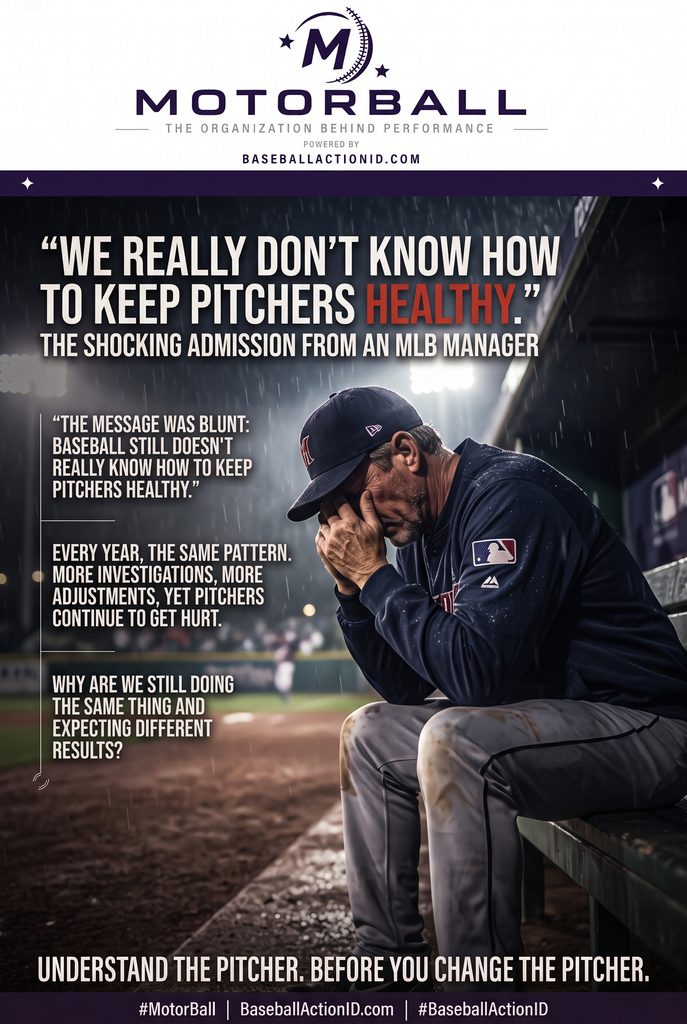
The MLB injury picture
Look at the injury history within that same MLB environment.
- April 18, 2025 — Pitcher 1: UCL revision surgery, involving a full reconstruction. He missed almost the entire 2025 season.
- October 2025 — Pitcher 2: A second Tommy John procedure combined with a flexor repair. He was expected to miss the entire 2026 season.
- February 2026 — Pitcher 3: Forearm inflammation and radial nerve irritation. An MRI showed no UCL damage. He subsequently began the season on the injured list.
- February 2026 — Pitcher 4: Elbow flexor strain. He was shut down and subsequently placed on the injured list.
- April 2026 — Pitcher 5: Biceps strain, resulting in an injured-list placement.
- April 2026 — Pitcher 6: Initial wrist tightness followed by forearm discomfort. Further examination confirmed a torn UCL, resulting in season-ending surgery.
Six pitchers. Six significant arm-related injury situations within the same MLB environment.
Two of these pitchers are particularly relevant to my analysis because I identified a fundamental misclassification in their natural movement organization.
What about the other four?
I don’t have access to the original movement classifications assigned to those pitchers, so I cannot establish whether the same misidentification occurred in their cases.
But that raises an important question: Could similar mismatches also have been present in their development?
If a pitcher’s natural movement organization is incorrectly identified, the development decisions built around that classification can be fundamentally misaligned with the individual.
And if that happens repeatedly, across multiple pitchers within the same organization, we are no longer looking at an isolated mistake. We are looking at a potential systemic problem in how pitchers are being identified and developed.
The two cases I identified demonstrate that this type of misclassification can occur. The remaining injury cases raise the question of how widespread the problem may actually be.
You cannot build an individualized development model on a misclassified pitcher.
This is bigger than one organization
It would be convenient to look at this example and conclude that it represents an isolated organizational problem.
I don’t believe that is the case.
Across professional baseball, organizations are investing enormous resources in understanding pitching performance.
They are measuring velocity, spin rate, spin direction, release height, release side, extension, arm slot, movement profiles and countless other variables.
They are studying mechanics, analyzing video, evaluating physical characteristics and developing increasingly sophisticated pitch-design programs.
There is more information available than ever before.
Yet the industry continues to struggle with an increasingly serious problem: pitchers are getting hurt, development plans are being questioned, and organizations are constantly searching for explanations.
The discussions often revolve around training methods, throwing frequency, between-start bullpens, weight training, mechanics, arm slots, release points, pitch mix and velocity.
These are all legitimate areas of investigation.
But there is a more fundamental question that is still not receiving the attention it deserves:
Are we correctly identifying the individual before we start making decisions about how that individual should move?
Because if the answer is no, then all the additional information may simply make us more sophisticated at developing the wrong solution.
Another MLB environment. Another injury cluster.
Consider another MLB organization that experienced a significant concentration of UCL-related injuries among its young pitchers during 2026.
Several pitchers underwent UCL-related procedures.
The resulting discussions included questions about weight training, throwing frequency, between-start bullpen sessions, mechanics, arm slots, release points, pitch mix, velocity, analytics and the relationship between data-driven decisions and the experience of pitching coaches.
Again, these are relevant questions.
But notice the pattern.
When injuries accumulate, the industry examines the visible components of pitching development and tries to determine which variable is responsible.
Is it the training?
Is it the throwing program?
Is it the mechanics?
Is it the pitch mix?
Is it the velocity?
Is it the way the arm is being used?
We keep examining the components.
But where is the fundamental examination of the individual?
Where is the systematic effort to understand how that pitcher naturally organizes movement before we start imposing development strategies on him?
The issue is not that every injury in every organization has one identical explanation.
The issue is that the industry continues to make highly individualized development decisions without necessarily establishing the most fundamental information about the individual.
And that is a serious blind spot.
Individualization starts before pitch design
Let’s return to pronation and supination.
The current discussion around individualized pitch design often focuses on identifying a pitcher’s tendencies, examining his arm slot, experimenting with grips, analyzing release orientation and finger pressure, and measuring the resulting ball flight.
There is value in all of that.
But it is not where individualization should begin.
The forearm does not operate independently from the rest of the body.
A pitcher’s natural movement organization influences how the entire system coordinates movement. The arm and forearm are part of that organization, not isolated mechanisms that can be understood simply by examining what happens at release.
This is why identifying a pitcher as a pronator or supinator based solely on an observed expression can be misleading.
We need to distinguish between what the athlete does and how the athlete naturally organizes movement.
Those are not necessarily the same thing.
And the difference becomes particularly important when we start making development decisions.
If a pitcher’s natural organization is misidentified, recommendations about arm action, release strategies and pitch development may be based on an incorrect interpretation of the athlete.
The result is not genuine individualization.
It is an attempt to fit the individual into a model built around a mistaken understanding of that individual.
More data does not automatically mean better understanding
Modern baseball has become exceptionally good at measuring performance.
TrackMan tells us what the ball does.
Biomechanics can help us understand how movement is expressed.
Video allows us to observe movement patterns. Physical assessments provide additional information about the athlete.
All of these tools have value.
But none of these measurements, by themselves, establishes the athlete’s underlying Motor Signature.
That distinction should not be dismissed.
A pitcher can have an excellent-looking delivery, repeatable mechanics and impressive performance metrics while still having a development model that does not align with his natural movement organization.
The fact that a movement is repeatable does not automatically mean it is naturally organized.
The fact that a pitch produces a desirable result does not automatically mean the process used to produce it is the right long-term solution for that individual.
And the fact that an organization has collected thousands of data points does not guarantee that it understands the person behind those numbers.
The problem is not a lack of information. The problem is what the industry believes that information tells us.
The question the industry needs to answer
For years, baseball has been trying to optimize pitching performance by measuring more, analyzing more and refining mechanics and pitch design.
But there is a fundamental step that should come before those decisions.
Identify the individual correctly.
Understand the athlete’s natural movement organization.
Understand how that organization expresses itself throughout the body.
Then interpret the observed movement, evaluate the delivery and determine how pitch development can best align with that individual.
This does not mean abandoning TrackMan, biomechanics, video analysis or pitch-design technology.
It means understanding what each tool can tell us — and, just as importantly, what it cannot tell us.
The industry cannot continue to confuse an observable movement expression with the underlying organization that produces it.
And it cannot claim to individualize pitcher development while overlooking the most fundamental characteristics of the individual.
The examples discussed here point to a problem that deserves far more attention across professional baseball.
This is not simply about pronators and supinators.
It is about the foundation on which pitching development decisions are made.
You cannot individualize development if you haven’t correctly identified the individual.
You cannot build the right pitch around the wrong understanding of the pitcher.
And if we continue to overlook the organization behind the movement, we should not be surprised when increasingly sophisticated development systems fail to deliver the results we expect.
It’s time to look beyond the movement we see.
It’s time to understand the organization behind it.