The Hidden Motor Conflict Behind Pitching Injuries
The Hidden Motor Conflict Behind Pitching Injuries
Every spring, the same pattern shows up.
Oblique strains.
Elbow issues.
UCL damage.
Different players.
Different organizations.
Same outcome.
And every year, the same question gets asked:
Why do pitchers keep breaking down?
But maybe that’s the wrong question.
The Missing Link Between Performance and Injury
In the previous article, we looked at what happens when a pitcher finally moves in line with his natural motor organization.
Velocity jumped.
Effort dropped.
The arm started moving freely again.
Not because something new was added.
But because something unnatural was removed.
That story was about alignment.
This one is about the opposite.
What happens when a pitcher is consistently pushed outside his natural release window?
Because that’s not rare.
That’s happening across baseball—every single day.
The Problem with How We Look at Injuries
In baseball, injuries are still mostly analyzed locally.
The elbow hurts.
The shoulder breaks down.
The oblique tears.
So the focus stays there:
- Arm action
- Shoulder strength
- Elbow stress
But the body doesn’t operate in isolated parts.
It operates as a system.
And when that system is forced outside its natural organization, it doesn’t stop functioning.
It adapts.
Introducing Motor Conflict
When movement aligns with a pitcher’s natural motor organization, everything starts to clean up.
Timing becomes more precise.
Energy transfer improves.
The arm works inside its natural release window.
This is the foundation of the ActionTypes approach—performance built by respecting how the individual is naturally organized, not by forcing external models.
But when that alignment is disrupted—often with good intentions—a different process begins.
Motor conflict.
A mismatch between how the system is built to organize movement…
and how it is being asked to move.
What Happens Next (The Part Most People Miss)
When motor conflict is introduced, the body doesn’t shut down.
It finds a way.
It always does.
That’s where compensation begins.
Not as an error.
But as a solution.
The Hidden Chain Reaction
This is the sequence that plays out more often than most people realize:
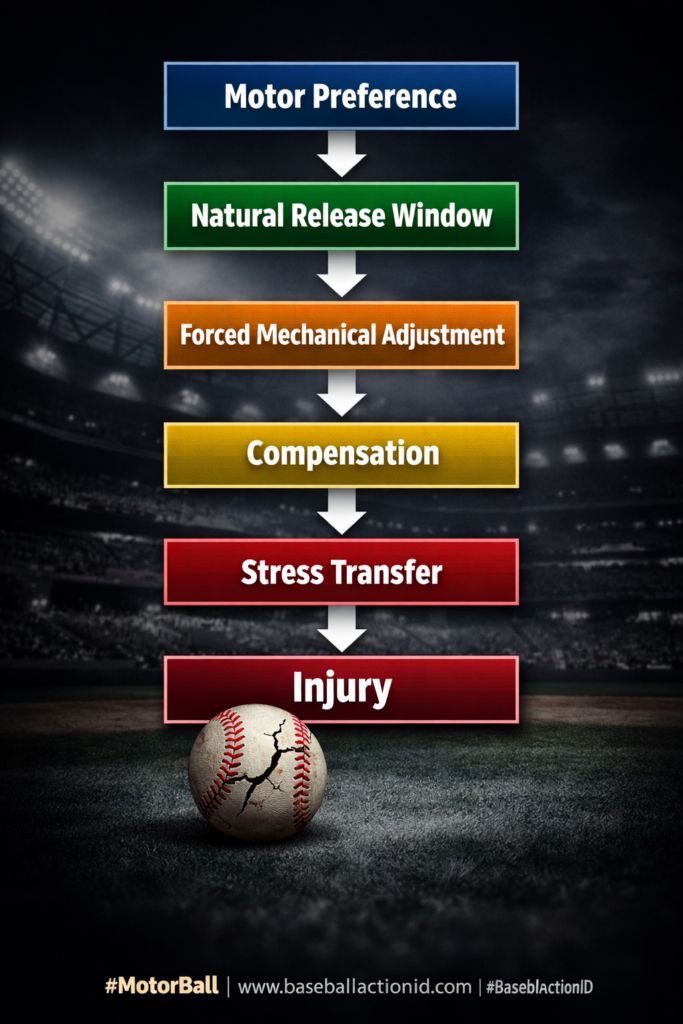
The injury is not the starting point.
It’s the end result.
What Compensation Really Means
Compensation is often treated as something negative.
It isn’t.
Compensation is a functional response.
It allows the system to:
- Keep performing
- Maintain output
- Survive the constraint
Compensation keeps the system going.
But that’s exactly the problem.
Because over time…
It becomes the reason it breaks.
Where It Starts to Break Down
At first, nothing seems wrong.
The pitcher still performs.
Velocity is still there.
Command can even hold.
Sometimes it even looks better.
But underneath:
- Repetition accumulates
- Fatigue builds
- Stress concentrates
And the system keeps solving the same problem…
over and over again.
Until it can’t.
Where Arm Slot Comes Back Into the Picture
In the previous articles, we showed that the arm slot is not a mechanical choice.
It’s the visible expression of a pitcher’s motor organization.
Each pitcher operates within a natural release window.
That’s not a style.
It’s a constraint.
So when a pitcher is pushed outside that window:
- The arm still has to deliver
- The system still has to produce velocity
- The body still has to find a solution
And it does.
Through compensation.
A Different Way to Look at Pitching Injuries
Instead of asking:
“How do we fix the arm?”
A better question might be:
What forced the system to compensate in the first place?
Because until that’s addressed, the system will keep finding ways to cope.
And every solution comes with a cost.
The Real Takeaway
Pitchers don’t just break down.
They compensate—over and over again—
until the system runs out of options.
And by the time the injury shows up, the real problem has often been there for much longer.
Not in the arm.
But in how the movement was forced to organize.
A different starting point is needed.
One that recognizes how the body naturally coordinates movement.
That is where the ActionTypes approach, and its translation into baseball through #MotorBall, begins.