
The Silent Struggle of a Young MiLB Pitcher
What Happens When Development Quietly Disconnects an Athlete from Himself
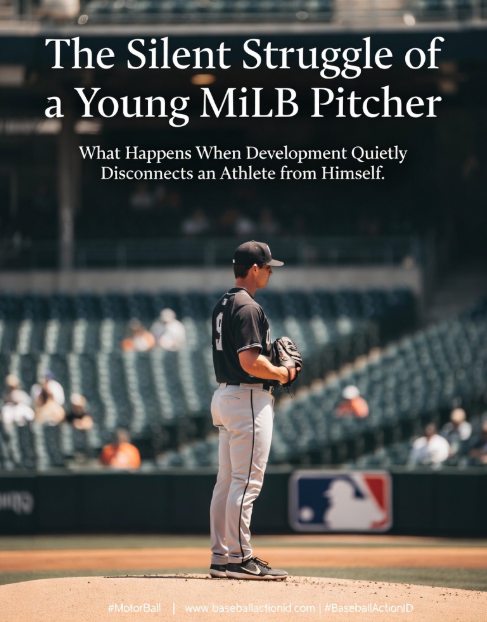
At #BaseballActionID, we hear these stories more often than most people realize.
Not dramatic ones.
Not headline stories.
Quiet ones.
From pitchers who are still rostered.
Still training.
Still “developing”.
But who no longer recognize themselves in what they’re doing.
A pitcher who was doing what he was told
This story came from a coach we’ve known for years.
He described a young MiLB pitcher — talented, durable, committed —
who had always relied on feel, rhythm, and trust in his delivery.
Nothing flashy.
Nothing forced.
Just a way of moving that worked for him.
When the pitcher entered a new development environment, the message wasn’t hostile.
It was structured.
Organized.
Well-intended.
“We’re just going to clean a few things up.”
The changes made sense — individually
The cues weren’t extreme.
They rarely are.
• Hold this position longer
• Create more intent here
• Stay tighter there
• Match the model more consistently
Each adjustment sounded reasonable on its own.
And at first, the pitcher complied.
From the outside, it looked like progress.
What nobody noticed
What changed wasn’t his effort.
It was his relationship to his own movement.
The delivery no longer felt automatic.
Timing had to be managed consciously.
Execution required constant attention.
Instead of trusting the throw, he started monitoring it.
That’s the moment most systems miss:
When an athlete still performs — but no longer feels at home in his own body.
The cost of forced alignment
Nothing collapsed.
Velocity didn’t disappear overnight.
Command didn’t vanish in one outing.
But everything started to feel heavier.
Warm-ups took longer.
Feel came later — if at all.
Confidence became conditional.
The pitcher wasn’t broken.
He was disconnected.
Why don’t systems see this phase?
Development systems are built to reward:
• Visible change
• Positional consistency
• Compliance with the model
What they don’t measure:
• Loss of internal timing
• Erosion of natural rhythm
• Cognitive load during execution
• Declining trust in feel
By the time these show up in performance, the damage is already done.
What was actually missed
The issue was never mechanics.
It was that a generalized template was slowly overwriting the pitcher’s natural organization of movement.
Not because anyone meant harm —
But because the system had no language for differences.
The difference gets corrected.
Not interpreted.
The quiet danger
This pitcher didn’t push back.
Most don’t.
He assumed the discomfort was part of growth.
That the loss of feel meant he needed to work harder.
That’s how systems unintentionally teach athletes to distrust themselves.
And once that trust is gone, performance becomes fragile — even when it still looks acceptable.
Why this matters
This phase is where most careers quietly turn.
Not with injury.
Not with failure.
But with misalignment.
And unless development starts by understanding how an athlete naturally organizes movement under pressure, improvement will keep coming at the cost of identity.
Final thought
At #BaseballActionID, this way of reading the individual before changing them is what we later formalized as #MotorBall.
Not as a system to impose.
But as a reminder that development doesn’t start with fixing.
It starts with listening.