The Silent Struggle of a Young MiLB Pitcher: When “Improvement” Isn’t Always the Answer
In professional baseball, young pitchers often face expectations that can feel overwhelming.
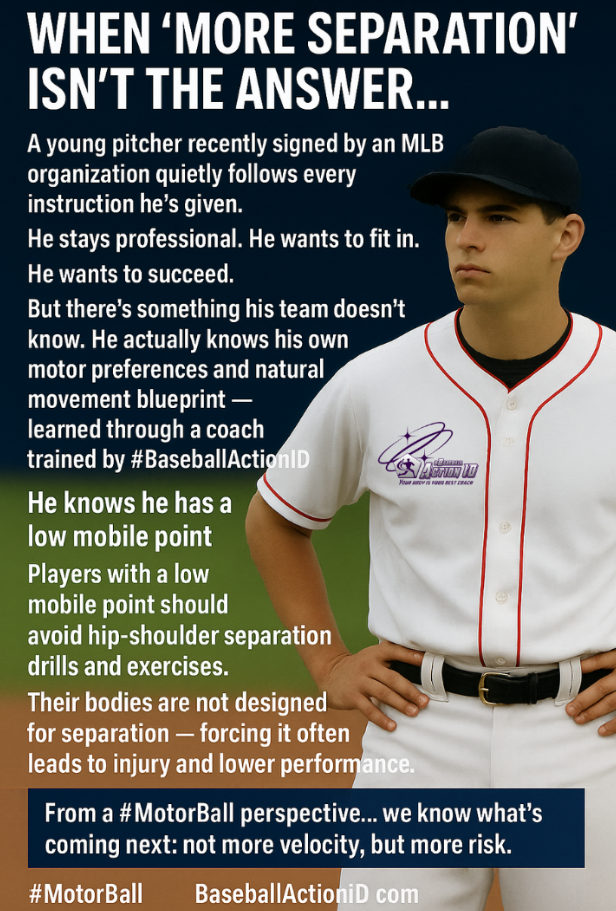
Recently, one promising pitcher, newly signed by an MLB organisation, has been quietly navigating these pressures—balancing a desire to improve with the knowledge of his own body.
This player comes equipped with a rare understanding:
This pitcher knows his own motor preferences and natural movement blueprint, having worked closely with a coach trained with #BaseballActionID.
He understands, for example, that he has a low mobile point, meaning his body moves in specific, naturally efficient ways. Importantly, individuals with a low mobile point should avoid hip-shoulder separation drills and exercises, because their bodies are not built for these movements.
Performing such drills can lead to injury and decreased performance rather than the intended improvements.
Despite this, his organisation, like many, is operating without awareness of his individual motor blueprint.
They’ve asked him repeatedly to perform hip-shoulder separation drills to increase velocity—but these attempts have not only failed to produce results, they have already caused minor injuries, including repeated tailbone strains.
The pitcher remains professional and committed. He silently complies, doing what is asked to maintain his place on the roster, all while knowing internally that this approach is not aligned with his body’s natural movement patterns.
Now, the organisation has recommended an even more intensive program focused on hip-shoulder separation to improve velocity.
From a #MotorBall standpoint, the outcome is predictable:
Not only is this unlikely to increase performance, but it also raises the risk of injury.
The very drills intended to enhance him may undermine both his performance and his long-term health.
This situation highlights a crucial point for all coaches and organisations: performance isn’t just about more effort, more drills, or more intensity.
It’s about aligning training with the athlete’s natural motor preferences, respecting their body’s blueprint, and cultivating excellence in a way that is sustainable and safe.
For young pitchers, the silent struggle is a real concern.
They want to fit in, to perform, and to impress—but when programs overlook their unique motor design, even the most talented athletes may struggle to meet expectations.
At BaseballActionID and through #MotorBall, our mission is to empower players and coaches with knowledge about natural motor preferences—so that training enhances, rather than hinders, performance.
By respecting the blueprint of each individual, organisations can unlock true potential while minimising unnecessary risk.