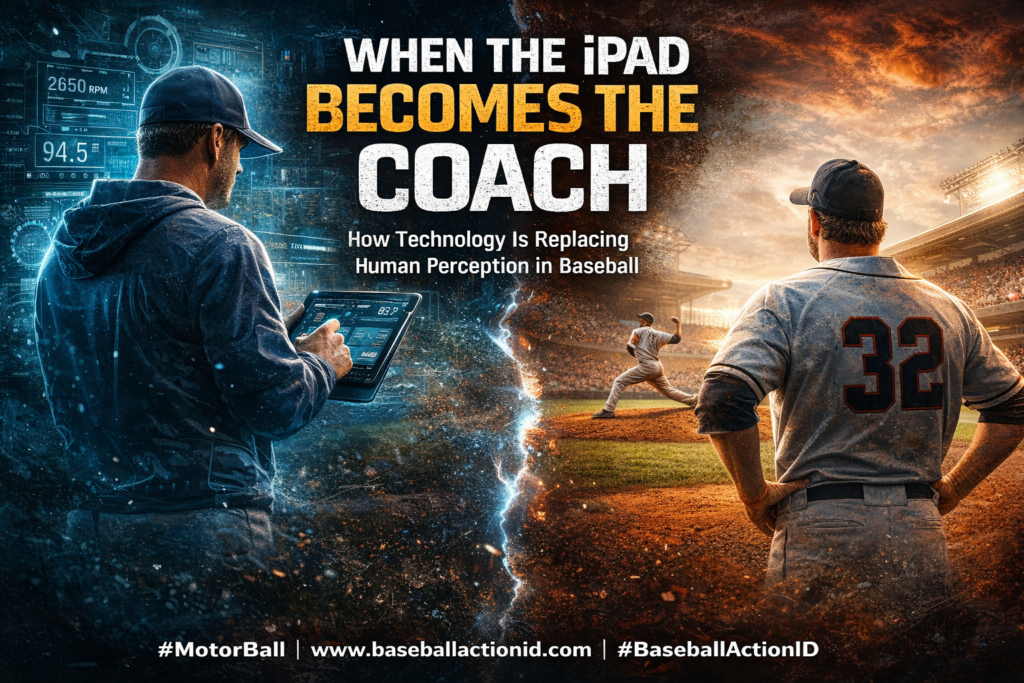
When the iPad Becomes the Coach
How Modern Player Development Is Learning to Read Screens Instead of Humans
Spring Training just started.
And within days, the messages already started coming in.
Not about velocity.
Not about pitch design.
Not about biomechanics.
Not about workloads.
But about screens.
About iPads.
About numbers.
About metrics.
About dashboards.
About coaches watching data instead of humans.
One message summed it up perfectly:
“Steve, today we have coaches who stare at the iPad but barely look at the pitcher’s actual arm action. Sometimes they’ll say ‘good pitch’ without even seeing the pitch — just by checking the numbers on the iPad.”
Read that again.
Good pitch.
Without seeing the pitch.
Without seeing the arm.
Without seeing the body.
Without seeing the movement.
Without seeing the delivery.
Without seeing the stress.
Without seeing the compensation.
Just the screen.
Just the numbers.
Just the dashboard.
Welcome to the iPad Coaching Era
This is modern baseball development.
Where:
- Screens validate reality
- Dashboards define quality
- Metrics replace observation
- Models replace movement
- Numbers replace nuance
The pitch doesn’t need to look good.
The pitcher doesn’t need to move well.
The delivery doesn’t need to be clean.
The arm doesn’t need to be efficient.
If the numbers are good, the pitch is good.
If the metrics align, the pitch is “quality”.
If the dashboard says yes, the coach says yes.
This is no longer coaching.
This is metric confirmation culture.
The Most Dangerous Shift in Player Development
We didn’t lose coaching skills overnight.
We retrained our attention.
We taught an entire generation of coaches to:
- Look at outputs instead of inputs
- Read data instead of bodies
- Trust dashboards instead of perception
- Value metrics over movement
- Validate models over humans
The screen became the authority.
Not the athlete.
Not the movement.
Not the coordination.
Not the rhythm.
Not the timing.
Not the motor organization.
Not the stress patterns.
Not the compensations.
Not the fatigue signals.
“Good Pitch” — But Good for What?
Good for velocity.
Good for vertical break.
Good for induced movement.
Good for model fit.
Good for profile alignment.
Good for system standards.
But is it good for:
- The elbow?
- The shoulder?
- The lat?
- The oblique?
- The scap load?
- The thoracic rhythm?
- The kinetic chain?
- The long-term health?
- The sustainability?
- The nervous system?
The screen can’t see:
- Compensation patterns
- Protective strategies
- Forced mechanics
- Stress redistribution
- Coordination breakdown
- Fatigue masking
- Survival movement
- Motor conflict
- Structural overload
The iPad sees numbers.
The body carries the consequences.
The Illusion of Precision
We think we’re being more precise than ever.
But we’re actually becoming more blind than ever.
Because precision without perception is not intelligence —
It’s automation.
We’ve created a system where:
- Observation is optional
- Feel is dismissed
- Intuition is mistrusted
- Experience is secondary
- Human reading is undervalued
- Movement literacy is disappearing
We are producing coaches who can interpret dashboards
but cannot read bodies.
Who can analyze charts
but cannot see coordination.
Who can explain metrics
but cannot diagnose movement.
Who can design profiles
but cannot protect athletes.
This Is How Injury Becomes “Unavoidable”
This is how breakdown becomes “normal”.
This is how surgeries become “part of the process”.
This is how oblique tears become “random”.
This is how elbow injuries become “genetic”.
This is how shoulder issues become “load problems”.
This is how careers end quietly.
Because the system keeps saying:
“The numbers look good.”
Until the body says:
“I’m done.”
The Core Problem Isn’t Technology
Technology isn’t the enemy.
Data isn’t the problem.
Metrics aren’t evil.
Models aren’t useless.
The problem is replacement.
We didn’t add technology to coaching.
We replaced coaching with technology.
We didn’t enhance observation.
We outsourced it.
We didn’t support perception.
We disabled it.
We didn’t improve development.
We automated it.
MotorBall Exists Because of This Moment
This is exactly why #MotorBall exists.
Not to fight data.
Not to reject technology.
Not to oppose analytics.
But to restore the human layer:
- Movement before metrics
- Observation before output
- Coordination before calculation
- Motor organization before models
- Human before system
- Athlete before algorithm
Because baseball is not played by dashboards.
It’s played by nervous systems.
By coordination systems.
By perception systems.
By motor systems.
By biological systems.
By human systems.
The Hard Truth
A pitcher is not a data generator.
An arm is not a metric source.
A body is not a dashboard.
A human is not a model.
And a screen will never tell you:
- How a pitcher organizes force
- How do they sequence movement
- How they manage stress
- How do they protect tissue
- How they compensate
- How they adapt
- How they survive
- How they coordinate
- How they actually throw
You have to look.
You have to see.
You have to observe.
You have to read the human.
Final Reality Check
If a coach can say “good pitch” without seeing the pitch —
We don’t have a data problem.
We have a development culture problem.
We have an attention problem.
We have a perception problem.
We have a human disconnect problem.
Because when screens become more important than bodies,
systems become more important than athletes,
and models become more important than movement…
Player development stops being development.
It becomes compliance engineering.
Closing
Put the iPad down.
Look at the pitcher.
Watch the body.
Read the movement.
See the coordination.
Observe the arm action.
Understand the human.
Then use the data.
Not the other way around.
#MotorBall
Human movement is not standardized.
Human coordination is not uniform.
Human motor organization is not model-based.