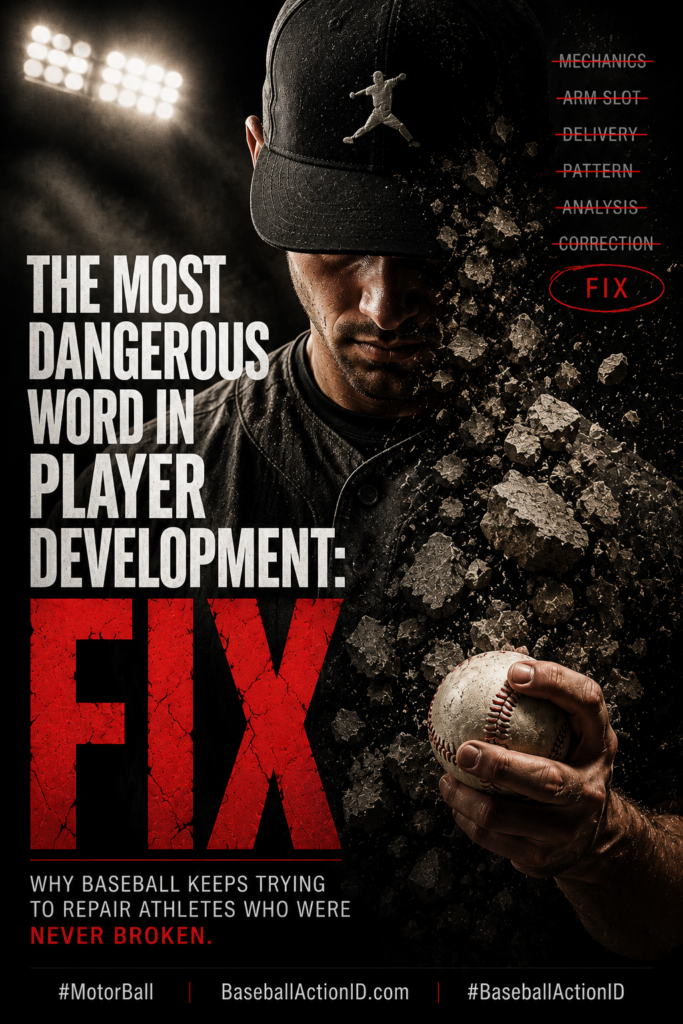
THE MOST DANGEROUS WORD IN PLAYER DEVELOPMENT: “FIX”
Why baseball keeps trying to repair athletes who were never broken in the first place
Last week, I wrote about what may become baseball’s next major development problem:
The misframing of motor preferences.
Not because organizations are ignoring individuality.
But because many are beginning to discuss motor preferences while still misunderstanding what motor preferences actually are.
And that distinction matters.
Because once a concept is misunderstood at the foundation, every decision built on top of that concept begins drifting in the wrong direction.
Even when the language sounds sophisticated.
Even when the technology looks advanced.
Even when the intentions are good.
But after reflecting on that article, I realized there is another word hiding underneath almost every player development mistake baseball continues to make.
A word so common that most people never question it.
A word that quietly drives mechanical overhauls, pitching interventions, movement corrections, velocity programs, and countless development plans across the sport.
That word is:
Fix.
And the more I think about it, the more convinced I become that “fix” may be one of the most dangerous words in modern player development.
The assumption nobody questions
Every time a coach says:
An assumption is already being made.
The assumption is:
Something is wrong.
Something is broken.
Something needs correction.
Something needs adjustment.
Something needs to be changed.
The problem is that this assumption is often made before anyone truly understands how the athlete naturally organizes movement in the first place.
And that creates a massive blind spot.
Because if the original movement solution was never understood…
How can anyone know whether it actually needs fixing?
Baseball’s development model is built on finding flaws
Look around modern baseball.
The system is designed to identify deficiencies.
- Velocity deficiency.
- Mechanical deficiency.
- Mobility deficiency.
- Strength deficiency.
- Command deficiency.
- Efficiency deficiency.
- Movement deficiency.
Everything starts with the search for what is wrong.
And to be fair, that approach makes sense if you’re working with machines.
Machines break.
Machines require correction.
Machines have optimal settings.
Machines can be recalibrated.
But athletes are not machines.
Athletes are adaptive biological systems.
And adaptive systems often solve movement problems differently.
Very differently.
The hidden danger of “fixing”
When coaches identify something that looks unusual, the immediate reaction is often:
“Let’s clean that up.”
“Let’s make that more efficient.”
“Let’s get him into better positions.”
“Let’s improve the pattern.”
The problem?
Unusual does not automatically mean dysfunctional.
Different does not automatically mean wrong.
An efficient-looking appearance does not automatically mean efficiency for that athlete.
This is where countless player development mistakes begin.
Because baseball often evaluates movement from the outside in.
It sees the delivery.
It sees the arm action.
It sees the release.
It sees the positions.
But it doesn’t always understand the organizational strategy underneath them.
And sometimes the very thing that appears inefficient externally is the exact thing allowing the athlete to organize movement effectively internally.
The graveyard of good intentions
Some of the biggest development failures I’ve witnessed did not come from bad coaching.
They came from good coaching.
People are genuinely trying to help.
People are genuinely trying to improve players.
People are genuinely trying to reduce injury risk.
People are genuinely trying to unlock performance.
The intentions were good.
The outcomes were not.
Because the intervention was built on a flawed assumption:
If it looks different, it probably needs fixing.
That assumption has quietly derailed countless careers.
Not because coaches lacked effort.
Not because organizations lacked resources.
But because nobody asked the most important question first:
“What problem are we actually trying to solve?”
The paradox baseball keeps creating
Here is the irony.
Many pitchers reach professional baseball because of the movement solution they naturally developed.
That movement solution helped them:
- Throw harder
- Command better
- Compete longer
- Survive pressure
- Adapt under stress
Then they enter a development system.
And suddenly, the same movement solution that got them there becomes the thing being targeted for correction.
Think about that for a second.
The athlete succeeded because of his solution.
Then gets told the solution is the problem.
This paradox happens every day throughout baseball.
What if the athlete isn’t broken?
This may be the most uncomfortable question in all of player development.
What if the athlete isn’t broken?
What if the delivery isn’t the problem?
What if the arm slot isn’t the problem?
What if the movement variability isn’t the problem?
What if the issue isn’t what the athlete is doing…
But our interpretation of what the athlete is doing?
That possibility rarely receives enough attention.
Because identifying problems feels productive.
Understanding an organization requires patience.
And patience is far less marketable than a quick fix.
The word that should replace “fix.”
If baseball wants to move forward, I believe one word needs to become less common.
Fix.
And another word needs to become more common.
Understand.
Before changing movement:
Understand it.
Before rebuilding mechanics:
Understand them.
Before assigning corrective drills:
Understand what the athlete is actually solving.
Before intervening:
Understand the organizational blueprint already operating underneath the surface.
Because once you truly understand the athlete, the developmental decision often changes completely.
Sometimes intervention is necessary.
Sometimes it isn’t.
But understanding should always come before fixing.
What #MotorBall is actually asking
#MotorBall is not asking baseball to stop coaching.
It is not asking organizations to stop developing players.
It is not arguing against improvement.
It is asking something much simpler.
Before deciding what needs to change…
First, understand what already exists.
Because movement is not randomly organized.
Athletes are not blank canvases.
And development should not begin with the assumption that every difference represents a flaw.
The greatest developmental breakthroughs often occur not when coaches force athletes into better solutions.
But when they finally understand the solution, the athlete was already using.
The uncomfortable truth
The future danger for baseball may not be that organizations misunderstand motor preferences.
I wrote about that last week.
The greater danger may be what happens after the misunderstanding.
Because once an athlete is misunderstood…
The next step is usually predictable.
The athlete gets fixed.
And sometimes the very process designed to help the player becomes the process that pulls him further away from the movement organization that made him successful in the first place.
Final
Maybe the most important question in player development is not:
“How do we fix this athlete?”
Maybe it is:
“What if he doesn’t need fixing?”
Because the difference between those two questions can change an entire career.
And until baseball learns to distinguish between dysfunction and individuality, the sport may continue spending enormous amounts of time, money, and resources fixing athletes who were never broken to begin with.