The Illusion of Certainty in Baseball: Why Data Can Break Players
What if the problem isn’t the data… but how we believe it?

In the previous article, we looked at something uncomfortable.
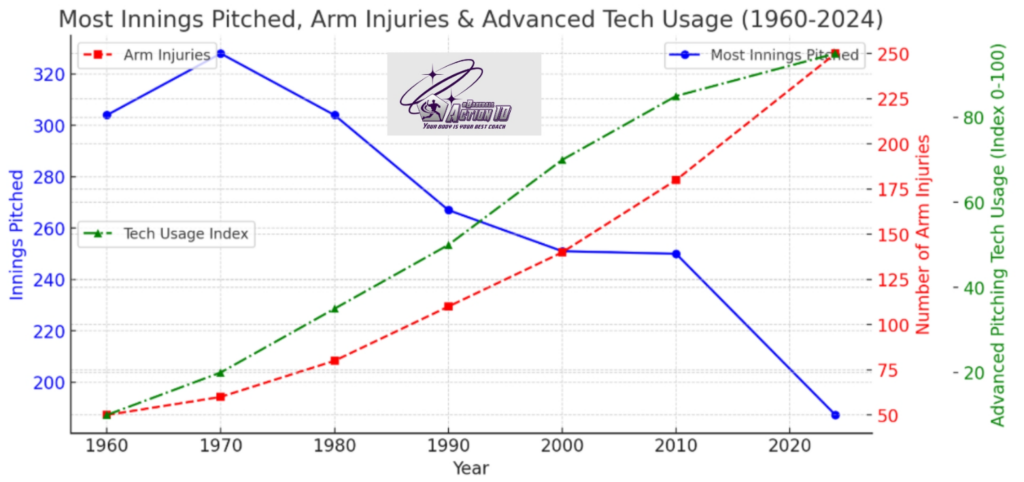
Pitch design is getting better.
The data is getting sharper.
And yet… pitchers keep breaking down.
Not immediately.
Not always dramatically.
But over time.
Which raises a different question.
Not about execution.
Not about effort.
But about something deeper.
What if the problem isn’t what we’re measuring…
But how do we interpret what we measure?
Baseball’s Belief in Numbers
Baseball today believes in numbers.
TrackMan.
Biomechanics labs.
Motion capture.
Pitch design models.
Everything is measured.
And because it’s measured…
It’s assumed to be true.
But that assumption is the real problem.
We’ve started to believe that:
If something can be expressed in numbers,
It must be objective, neutral, and correct.
It feels like certainty.
But in many cases…
It’s an illusion.
The Illusion of “Knowing”
Even outside baseball, this issue is well documented.
Researchers like John Ioannidis have shown that a large portion of published scientific findings are not reproducible.
Not because scientists are dishonest.
But because of how research works:
- Small sample sizes
- Weak effects
- Too many variables are tested at once
- Flexible interpretation of data
- Pressure to publish
All of this increases the chance that a “positive finding” is simply a coincidence… or misinterpretation.
Now add another layer.
According to Professor Mattias Desmet, the problem goes deeper than methodology.
We don’t just misuse data.
We believe too much in what data represents.
We treat the world as if it were a machine:
Something that can be fully measured.
Fully understood.
Fully controlled through numbers.
That belief creates what Desmet calls pseudo-objectivity:
Numbers look precise and objective,
But they can hide the real, living complexity underneath.
When we force human movement into numbers…
We don’t necessarily get closer to the truth.
We often move further away from it.
Now Look at Baseball
This is exactly what is happening in baseball today.
Movement is treated as something that can be:
- Measured
- Modeled
- Optimized
Pitchers are analyzed through:
- Arm slot
- Release point
- Kinematic sequence
Hitters through:
- Launch angle
- Bat path
- Rotational metrics
It all looks objective.
But here’s the critical question:
What if the numbers are accurate…
But the interpretation is wrong?
What the Data Doesn’t Show
A pitcher gains 3 mph.
Adds 3+ inches of horizontal break.
Everything looks better.
The model says it worked.
Six months later: elbow pain.
One year later: out.
The data said it worked.
The body said something else.
The Missing Piece: Motor Organization
This is where the ActionTypes approach fundamentally changes the conversation.
Not all athletes are organized the same way.
Movement is not just mechanics.
It is the result of:
- Perception
- Coordination
- Motor preferences (Motor signature)
- How the body interacts with gravity
Two athletes can produce the same measurable output…
But through a completely different internal organization.
And that changes everything.
Because when you apply the same mechanical model to differently organized athletes…
You don’t optimize them.
You disrupt them.
The Real Cost: Injuries Everywhere
This is not theoretical.
Look at the reality of the game:
- Tommy John surgeries
- Oblique strains
- Lat injuries
- Shoulder breakdowns
- Thoracic outlet syndrome
And it’s not just pitchers.
Hitters are dealing with:
- Oblique tears
- Back issues
- Rotational stress injuries
At the same time:
Baseball has more data than ever before.
That’s the paradox:
More measurement.
More optimization.
More breakdown.
Why This Keeps Happening
Because baseball is trying to solve a human problem with a mechanical model.
It assumes:
- There is one optimal movement
- One efficient pattern
- One correct way to throw or swing
But according to ActionTypes:
That assumption is fundamentally flawed.
Efficiency is not universal.
It is individual.
When a player is forced into a pattern that does not match his motor preferences/motor signature:
- Timing breaks
- Coordination degrades
- Compensation increases
- Stress shifts to vulnerable tissues
That’s where injuries are born.
Not from effort.
Not from intensity.
But from:
Misalignment between instruction and organization.
From Measurement to Misinterpretation
Let’s connect the dots.
Ioannidis shows:
→ Even controlled data can be unreliable
Desmet shows:
→ We overestimate what data actually tells us
Now apply that to baseball:
We take:
- Imperfect data
- Limited models
- Simplified metrics
And apply them to:
- Highly complex
- Individually organized
- Living systems
And treat the result as truth.
That’s not a small mistake.
That’s a systemic misinterpretation problem.
Where #MotorBall Comes In
This is exactly why #MotorBall exists.
Not to reject data.
But to put data back in its proper place.
#MotorBall, grounded in ActionTypes, starts from a different question:
How is this athlete organized?
Instead of:
- Forcing mechanics
- Chasing ideal positions
- Copying models
It focuses on:
- Motor preferences
- Coordination patterns
- Perception–action coupling
Only then does data become meaningful.
Only then can you:
- Improve performance
- Reduce injury risk
- Make better development decisions
The Real Eye-Opener
The problem in baseball is not a lack of data.
It’s the belief that data equals understanding.
Numbers can describe movement.
But they cannot explain the human behind it.
Until baseball integrates motor organization into its data interpretation…
The cycle will continue:
More data → more control → more misalignment → more injuries
Final Thought
Not everything that matters can be measured.
And not everything that is measured truly matters.
The next edge in baseball is not more technology.
It’s learning how to see the athlete again.