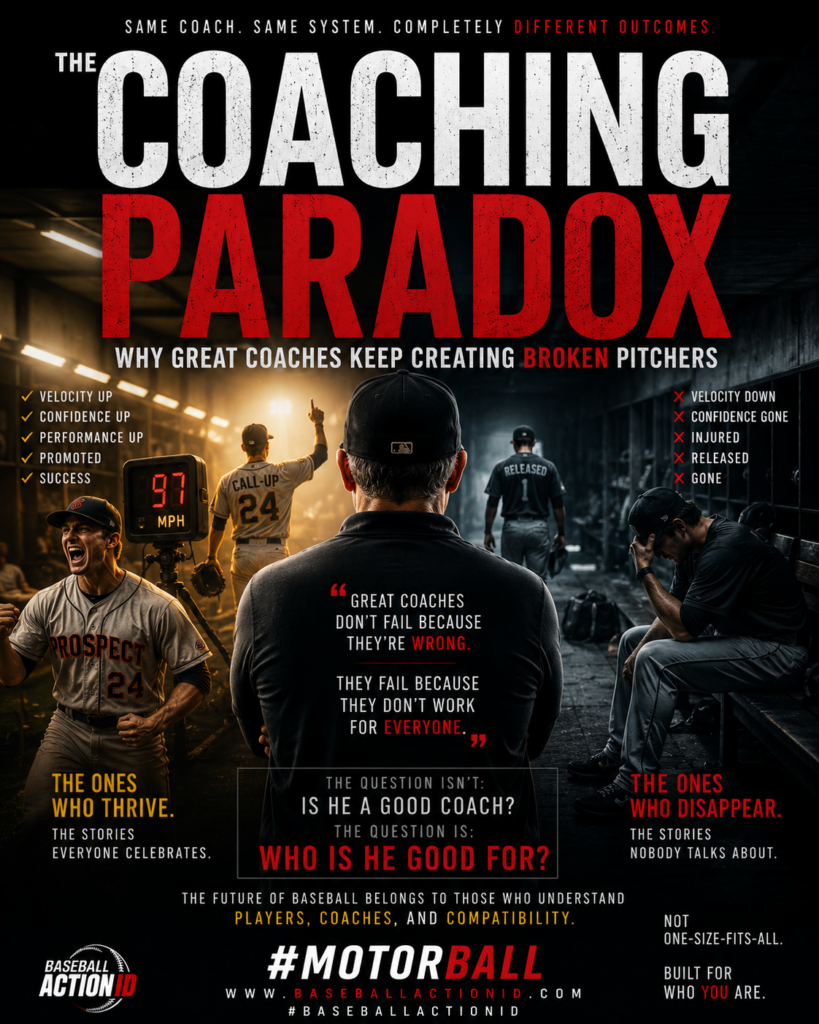
THE COACHING PARADOX
Why Great Coaches Keep Creating Broken Pitchers
In my previous article, I challenged one of baseball’s most sacred assumptions:
What if MLB isn’t developing players?
What if it’s selecting survivors?
The idea was simple.
When organizations point to the players who succeed, they often assume the system created that success.
But what if some of those players succeeded because they naturally fit the system?
And what if many of the players who struggled weren’t lacking talent at all?
What if they simply didn’t fit the model?
That leads to an even more uncomfortable question.
If players are fundamentally different…
Why do we assume the same coaching should work for everyone?
This Article Will Make Some Coaches Uncomfortable
Not because they’re bad coaches.
Not because they’re incompetent.
Not because they don’t care.
In fact, many of the coaches I’m talking about are excellent.
They’ve helped players reach college baseball.
Professional baseball.
Even the Major Leagues.
The problem isn’t that they’re wrong.
The problem is that baseball has convinced itself that a great coach should work for everyone.
And that assumption may be one of the most expensive mistakes in player development.
The Coach Who Changes One Career
Every coach has a success story.
A pitcher gains velocity.
A hitter unlocks power.
A struggling prospect suddenly takes off.
The coach becomes convinced:
“This is the answer.”
The player becomes proof.
The method gains credibility.
The organization embraces it.
And often, it genuinely works.
For some players.
The Players Nobody Talks About
But here’s what usually happens next.
The same coach applies the same concepts to more players.
Some improve.
Some stagnate.
Some regress.
Some get hurt.
Some lose confidence.
Some begin overthinking movements that once felt natural.
Yet baseball rarely questions the method.
Instead, it questions the player.
Maybe he didn’t buy in.
Maybe he wasn’t disciplined enough.
Maybe he wasn’t coachable.
Maybe he lacked commitment.
The coach stays the same.
The method stays the same.
The blame moves to the athlete.
The Hidden Bias Every Coach Carries
This is where MotorBall begins.
Every coach has preferences.
Not just coaching preferences.
Movement preferences.
Perception preferences.
Coordination preferences.
Problem-solving preferences.
The way a coach naturally organizes movement often influences what he sees as “correct.”
The cues that make perfect sense to him.
The drills he believes in.
The patterns he notices.
The movements he rewards.
Without realizing it, many coaches teach what feels natural to them.
And what feels natural to them is not natural for everyone else.
Why One Pitcher Thrives While Another Breaks
Imagine two pitchers.
Both are talented.
Both work hard.
Both trust the coach.
Both follow instructions.
One pitcher gains velocity.
Improves command.
Feels more athletic.
Stays healthy.
The other loses command.
Feels restricted.
Starts fighting his delivery.
Develops discomfort.
Eventually gets hurt.
Baseball often sees this as a mystery.
MotorBall does not.
Because the question isn’t:
“Did the coaching work?”
The question is:
“For whom did the coaching work?”
Coaching Is Not Universal
This is the idea baseball struggles to accept.
A coach can be outstanding.
A coach can be knowledgeable.
A coach can be highly successful.
And still be the wrong coach for certain athletes.
Not because the coach lacks expertise.
But because the athlete organizes movement differently.
The athlete solves movement problems differently.
The athlete processes information differently.
The athlete stabilizes differently.
The athlete generates force differently.
In other words:
The athlete is not broken.
The fit is.
The Industry’s Most Dangerous Assumption
For decades, baseball has searched for universal solutions.
The ideal mechanics.
The ideal arm action.
The ideal movement pattern.
The ideal development pathway.
The ideal coaching language.
But what if no universal solution exists?
What if coaching effectiveness is partly determined by compatibility?
That possibility changes everything.
Because now success isn’t only about how good a coach is.
It’s also about who the coach is working with.
Great Coaches Don’t Fail Because They’re Wrong
This is the paradox.
Great coaches don’t fail because they’re wrong.
They fail because they assume what works for one motor signature should work for all of them.
And baseball encourages that assumption.
When a method creates success, organizations often expand it.
Scale it.
Standardize it.
Systemize it.
The very thing that creates efficiency may also create casualties.
Because standardization inevitably favors some athletes while disadvantaging others.
What If Coaching Needs To Be Scouted Too?
Baseball spends millions scouting players.
Velocity.
Strength.
Athleticism.
Pitch characteristics.
Movement quality.
Yet almost nobody scouts coaching compatibility.
Nobody asks:
Which athletes does this coach consistently elevate?
Which athletes consistently struggle under him?
Which motor organizations thrive with his communication style?
Which ones don’t?
Those questions may become some of the most important questions in the future of player development.
Final Thought
Baseball has spent decades trying to find better coaches.
MotorBall suggests a different possibility.
Maybe the next breakthrough isn’t finding better coaches.
Maybe it’s understanding which athletes each coach is naturally equipped to help.
Because the future of player development may not belong to organizations that standardize coaching.
It may belong to organizations that understand coaching compatibility.
And once baseball realizes that…
The conversation changes from:
“Is he a great coach?”
to:
“Who is he great for?”
And that’s where Part III begins.
Because the future GM won’t ask:
“Can he coach?”
He’ll ask:
“Who can he coach?”