MLB Lost $1 Billion in 2025 to Pitching Injuries. Nobody Changed the Cause.
When an industry keeps treating symptoms, the real damage often begins long before the injury report.

In the previous article, we looked at one of the most common explanations in modern baseball.
A pitcher struggles.
The velocity dips.
The command fades.
The ball no longer moves the same way.
Results turn quickly.
And almost on cue, the diagnosis arrives:
It’s a mechanical issue.
Something drifted.
Something got out of sync.
Something needs to be cleaned up, shortened, simplified, and corrected.
It is such a familiar response that it now feels normal.
But normal does not always mean true.
Because when the same sport keeps producing the same breakdowns, the same surgeries, the same vanished careers, the same talented arms who somehow lose what once made them dangerous, there comes a point where the honest question is no longer what happened to the player.
It becomes:
What keeps happening inside the system?
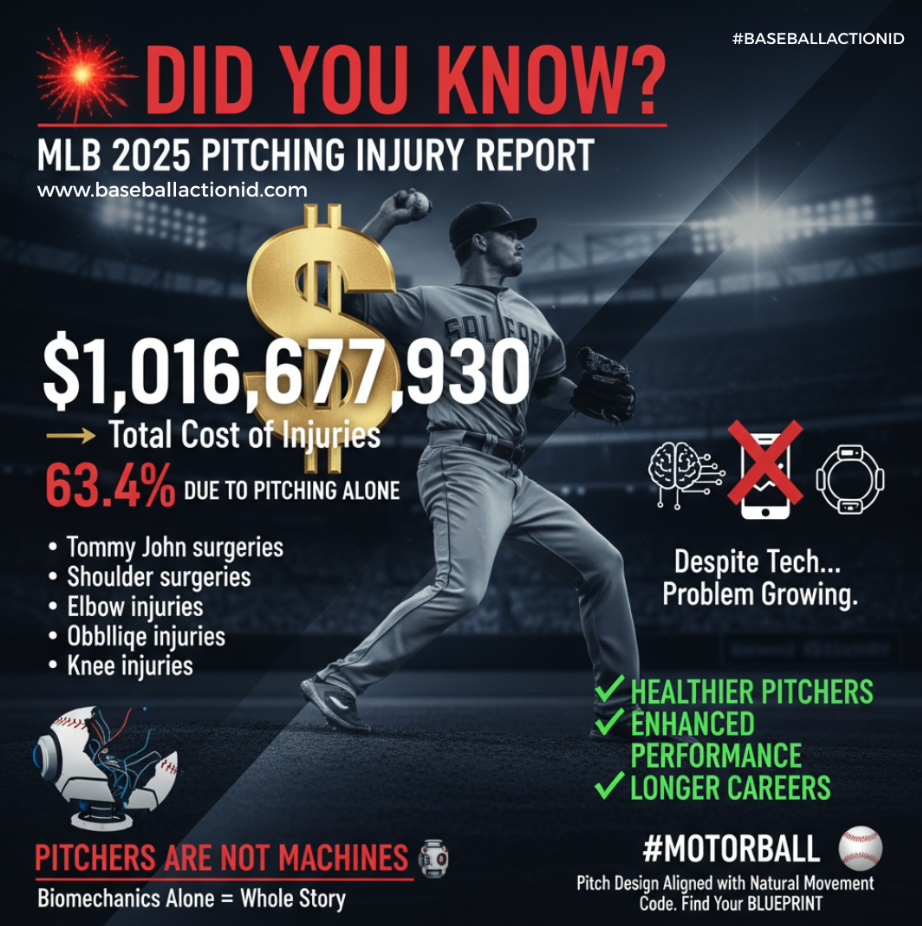
That question matters even more after reports that MLB lost roughly $1 billion to pitching injuries in 2025.
One billion dollars!
And that figure reflects pitching injuries alone.
In any serious industry, a number like that would trigger a deep internal audit. Not only of rehab protocols or medical timelines, but of assumptions. Of philosophy. Of whether the model itself is producing the losses it later tries to manage.
Instead, baseball largely continues in the same direction:
- More data
- More devices
- More monitoring
- More optimization
- More correction
Which raises the question nobody seems eager to ask:
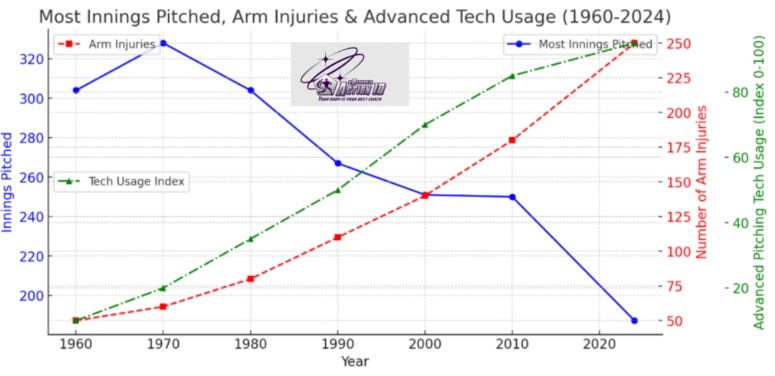
If the tools keep improving, why do the outcomes keep getting worse
Baseball has never known more about the ball.
It can track spin, axis, extension, release height, movement efficiency, vertical break, horizontal break, seam effects, force outputs, kinetic sequences, and nearly every measurable expression of the throw.
Yet knowing more about the Baseball is not automatically the same as understanding more about the human being throwing it.
That distinction may be where the entire problem lives.
Because modern development often behaves as if movement can be fully understood from outputs. If the ball moves a certain way, the athlete must be this type of mover. If the delivery looks a certain way, the solution must be mechanical. If the metrics improve, progress must be real.
The certainty is seductive.
It is also dangerous.
Nowhere is this clearer than in how confidently baseball speaks today about pronators and supinators.
A pitcher shows a certain movement profile. The ball runs a certain way. The spin behaves within a familiar pattern. Release characteristics match what the model expects.
And suddenly, the athlete is labeled.
Pronator.
Supinator.
As if the body can be understood from the final frame of the throw.
But release is not the beginning of movement.
Release is the end of it.
What happens at release may reflect natural organization. It may also reflect years of coaching interventions, timing adaptations, compensation strategies, pain avoidance, grip changes, learned survival patterns, or mechanical constraints layered onto the athlete’s original blueprint.
In other words, the data may be accurate about what happened—
while being incomplete about why it happened.
That difference is enormous.
I spoke with an MLB pitcher who was convinced he was a pronator. Every system around him had told him so. The reports said it. The language in development environments reinforced it. The movement outputs appeared to support it.
When we profiled how his system naturally organized movement, it became clear that he was not a pronator at all. He was a supinator operating through adaptations.
He looked stunned.
“So all that data lied to me?”
No.
The data described what it saw.
It simply never explained the system producing it.
And when description gets mistaken for identity, careers can drift in the wrong direction for years.
Sometimes all the way to surgery.
This is the blind spot hidden beneath much of modern baseball.
The sport often evaluates athletes from the outside in.
- How does it look?
- What does it measure?
- How does it compare?
- What shape does it produce?
- How quickly can it be optimized?
But elite movement does not begin on the outside.
It begins inside a living system,
trying to solve a task through coordination.
Every pitcher arrives with a natural organization — a blueprint for how timing, balance, rhythm, force transfer, orientation, perception, and stabilization are most efficiently coordinated for that individual.
That blueprint is not visible on a TrackMan report.
It is not fully captured in a force plate graph.
It does not reveal itself through one camera angle.
Yet it governs everything.
It determines whether a cue creates freedom or conflict.
Whether a new arm path creates power or hesitation.
Whether a mechanical change becomes progress or compensation.
Whether the body trusts the movement enough to express speed.
Or protects itself by reducing output.
This is where many so-called improvements quietly become problems.
A pitcher is told to shorten the arm path because shorter must be faster.
He becomes slower.
Another is told to clean up extra movement because less motion must be more repeatable.
He loses feel.
Another is told to chase a pitch shape that models well.
He gains movement but loses command.
Another is taught a delivery that looks cleaner on video.
Months later, the elbow pays the invoice.
From the outside, these outcomes feel confusing.
From the inside, they are often predictable.
Because the body is not trying to win a biomechanics argument.
It is trying to survive while performing.
When movement becomes mistimed, disoriented, or neurologically unclear, the system often protects first and performs second.
That protection may look like lost velocity.
Lost command.
Inconsistent release.
Fatigue.
Pain.
Breakdown.
The model sees symptoms.
The athlete feels conflict.
This is why the pitching injury crisis cannot be solved by medical departments alone.
Rehab matters. Diagnostics matter. Strength staffs matter. Recovery science matters.
But if development environments keep pushing athletes away from how they naturally organize movement, then the sport will remain excellent at treating damage while average at preventing it.
That is an expensive way to operate.
A billion-dollar pitching injury total is not just a financial statistic. It represents altered careers, stalled promotions, broken trust, diminished earning windows, and talent that may never fully return.
It is also a signal.
A signal that baseball may be overinvesting in outputs while underinvesting in understanding humans.
This is where ActionTypes principles offer a fundamentally different lens.
Not by rejecting data.
Not by rejecting technology.
But by restoring sequence.
Start with the athlete.
Start with how that individual naturally stabilizes, perceives, sequences force, and coordinates movement.
Start with the blueprint.
Then use technology to support what is true, rather than override what was never understood.
Because two pitchers can throw the same velocity through entirely different internal organizations.
The same cue can liberate one and injure another.
The same arm action can be natural for one and destructive for another.
The same correction can be genius in one locker and malpractice in the next.
That is not anti-science.
That is individualized science.
The next competitive edge in baseball may not be more spin data, more camera resolution, or another layer of dashboards.
It may be simpler.
Fewer broken pitchers.
More durable development.
More athletes operating inside systems their own bodies recognize and trust.
That would improve availability, performance continuity, long-term value, and player confidence all at once.
In business language, that is inefficiency waiting to be exploited.
In baseball language, that is, wins being left on the table.
Baseball reportedly lost $1 billion to pitching injuries in 2025.
But the larger loss may be harder to quantify.
How many players were never truly developed because they were endlessly corrected?
How many arms were called flawed when they were simply misunderstood?
How many surgeries began years earlier, the moment natural organization was replaced by model obedience?
At some point, the honest question is no longer:
How do we manage injuries better?
It becomes:
Why do we keep building systems that help create them?
That is where #MotorBall begins.
Not with the symptom.
With the source.