
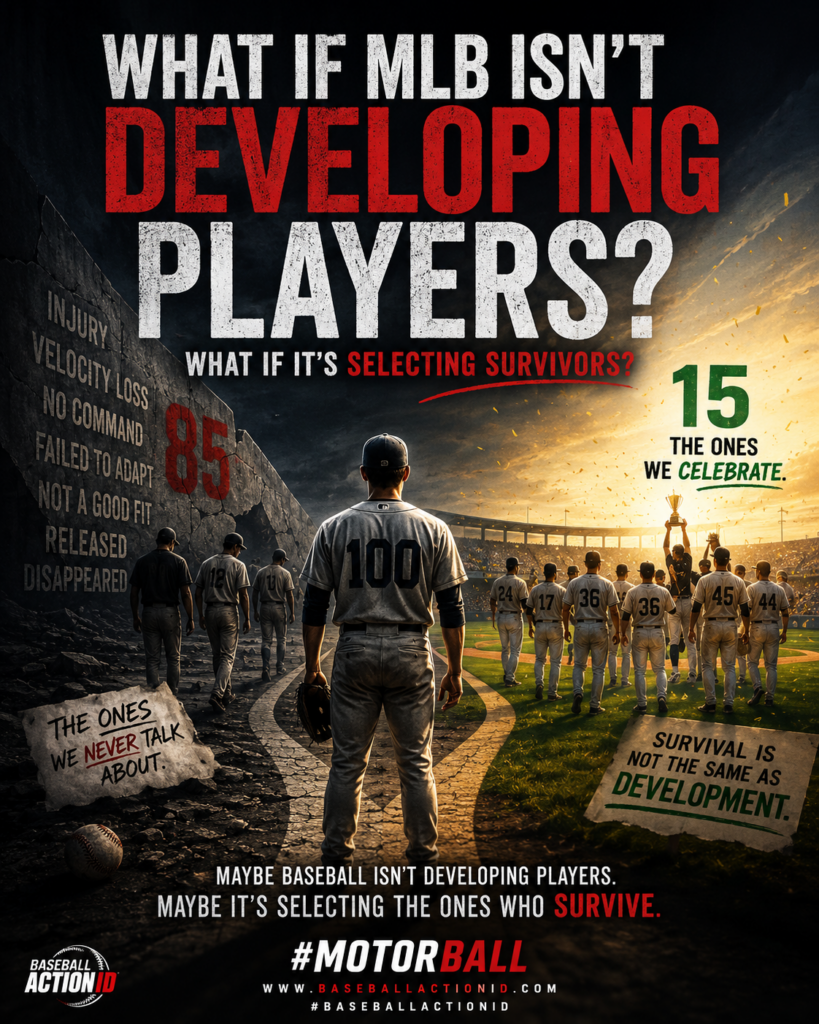
WHAT IF MLB ISN’T DEVELOPING PLAYERS? WHAT IF IT’S SELECTING SURVIVORS?
The uncomfortable question nobody wants to ask.
In my last article, I argued that the most dangerous word in player development might be one of the most commonly used:
Every year, thousands of players enter baseball development systems with the promise of improvement.
A better delivery.
A better swing.
A more efficient movement pattern.
A more optimized version of themselves.
The assumption is simple:
Find what’s wrong.
Fix it.
Get better.
But what if that’s the wrong question?
What if the real question isn’t whether we’re successfully fixing players?
What if it’s whether we’re breaking players in the process?
And that leads to an even more uncomfortable thought:
What if many organizations aren’t actually developing players at all?
What if they’re selecting the ones who survive their development model?
The Success Story Everyone Sees
A pitcher enters an organization throwing 89 mph.
Three years later, he’s throwing 96.
The organization celebrates the success.
The coaches get credit.
The development system gets praised.
The process gets validated.
Everyone points to the outcome and says:
“See? The system works.”
But there’s a problem.
Nobody talks about the players who disappeared along the way.
The Players We Never Talk About
For every success story, there are dozens of players who never make it.
Some lose velocity.
Some lose command.
Some lose confidence.
Some lose their health.
Some simply disappear from professional baseball.
Most are quietly labeled:
- Not athletic enough
- Not coachable enough
- Couldn’t adapt
- Lacked discipline
- Failed to buy in
Baseball often assumes the player failed.
But what if the system failed the player?
A Question Baseball Rarely Asks
Imagine 100 pitchers entering a development system.
Fifteen eventually reach the Major Leagues.
The organization points to those fifteen players as proof of success.
Fair enough.
But MotorBall asks a different question:
What happened to the other 85?
Not because every player should become a Major Leaguer.
That’s unrealistic.
But baseball rarely investigates whether some of those players failed because they were developed in ways that conflicted with their natural motor organization.
Survival Is Not The Same As Development
This is where things become dangerous.
When enough players succeed inside a system, the system assumes its methods are correct.
But survival and development are not the same thing.
A player may succeed because:
- His motor preferences naturally fit the coaching model
- His movement organization matches the drills
- His perception-action system aligns with the cues being taught
In other words:
He wasn’t developed by the system.
He was compatible with it.
The system simply revealed what was already there.
The Hidden Selection Process
Most organizations believe they are running development programs.
In reality, many may be running selection programs without realizing it.
The process often looks like this:
Players who naturally fit the model improve.
Players who partially fit the model struggle.
Players who fundamentally conflict with the model break down.
Then the survivors become proof that the model works.
The casualties quietly disappear from the conversation.
The Evolution Problem
Imagine trying to evaluate a farming strategy.
You plant 100 seeds.
Only 15 survive.
Then you study the survivors and conclude:
“These are the characteristics we should teach every seed.”
Sounds ridiculous.
Yet baseball often does something very similar.
The players who survive become the blueprint.
The players who didn’t survive are treated as exceptions.
But what if those “exceptions” are trying to tell us something?
Why This Matters More Than Ever
Modern baseball has more information than at any point in history.
More technology.
More biomechanics.
More force plates.
More motion capture.
More pitch design.
More data.
Yet injuries continue to rise.
Player turnover remains enormous.
And many organizations still struggle to consistently develop pitchers without sacrificing health or performance.
Maybe the issue isn’t a lack of information.
Maybe it’s the assumption that the same information should be applied to everyone.
The MotorBall Perspective
MotorBall starts from a different premise.
Human beings are not standardized.
Players do not organize movement the same way.
They do not perceive information the same way.
They do not coordinate force the same way.
They do not solve movement problems the same way.
So why would we expect them to respond to development in the same way?
The goal should not be to make every player fit the system.
The goal should be to understand the player first.
Then build development around the player.
Not the other way around.
The Question Every Organization Should Ask
Instead of asking:
“How do we get more players to follow our model?”
Perhaps the better question is:
“How many players are we losing because our model only works for certain types of players?”
That question is far more uncomfortable.
But it may also be far more valuable.
Because the greatest inefficiency in baseball may not be hidden in the players who succeed.
It may be hidden in the players who never had a chance to succeed within the system in the first place.
Final Thought
For years, baseball has measured development by looking at the players who made it.
MotorBall suggests looking somewhere else.
Look at the players who didn’t.
Look at the players who were labeled difficult.
The players who couldn’t repeat the movement.
The players who lost velocity.
The players who lost command.
The players who got hurt.
The players who were told they needed to be fixed.
Because sometimes the biggest question isn’t:
“Why did this player fail?”
It’s:
“Why did the system fail this player?”
And once baseball starts asking that question, everything changes.
Teaser naar Part II
In the next article, we’ll examine one of the biggest myths in baseball development:
The belief that a great coach should work for everyone.
Because what if the problem isn’t bad coaching?
What if it’s something much more complicated than that?
The Coaching Paradox: Why Great Coaches Keep Creating Broken Pitchers.