WHY PITCH DESIGN MAY BE PUSHING PITCHERS OUT OF THEIR HEALTHIEST RELEASE WINDOW
Introduction — from Pitch Tunneling to execution reality

In the previous article — Pitch Tunneling in Baseball: What If It Isn’t Universally Effective? — We explored a critical assumption in modern pitching analysis:
That reduced perceptual information affects all hitters in the same way.
That idea opened a new layer in how we look at performance:
Perception is not uniform across athletes.
But that was only one side of the equation.
Because while pitching analysis has focused heavily on how hitters see information (tunneling), a parallel shift has been happening on the other side:
How pitchers are being asked to become information systems themselves through pitch design.
And that raises a deeper question:
What happens when pitch design stops describing performance… and starts prescribing movement?
The modern shift: from pitcher-led to pitch-led development
Pitch design has become one of the most influential forces in modern baseball development.
Shape creation.
Movement profiles.
Release consistency.
Spin efficiency.
Optimization models.
All of it has meaning. All of it has value.
But structurally, something subtle has changed:
The pitch is no longer only an output of the pitcher.
In many environments, it has become a target to which the pitcher must conform.
That shift matters.
Because it changes the direction of development:
- From: What does this pitcher naturally produce?
- To: Can this pitcher match what we want the pitch to look like?
At first glance, that seems like progress.
But under the surface, it introduces a constraint that is rarely discussed:
The athlete is now being adapted to the pitch — instead of the pitch emerging from the athlete.
Information vs organization (the missing layer in pitch design)
Most modern pitching systems operate at the level of information:
- Velocity targets
- Movement goals
- Release consistency
- Pitch shape optimization
But performance does not originate at the information level.
It originates at the level of organization.
In MotorBall terms:
Information → Organization → Movement
Pitch design largely assumes:
Information → Movement
And that shortcut creates a blind spot.
Because two pitchers can receive identical information and still produce completely different outcomes — not because they execute differently, but because they are organized differently at a motor level.
The hidden constraint: release is not a free variable
This is where the connection to the previous article becomes important.
In Pitch Tunneling in Baseball, we discussed how perception is not universal across hitters.
Now we turn the mirror around:
Execution is not universal across pitchers.
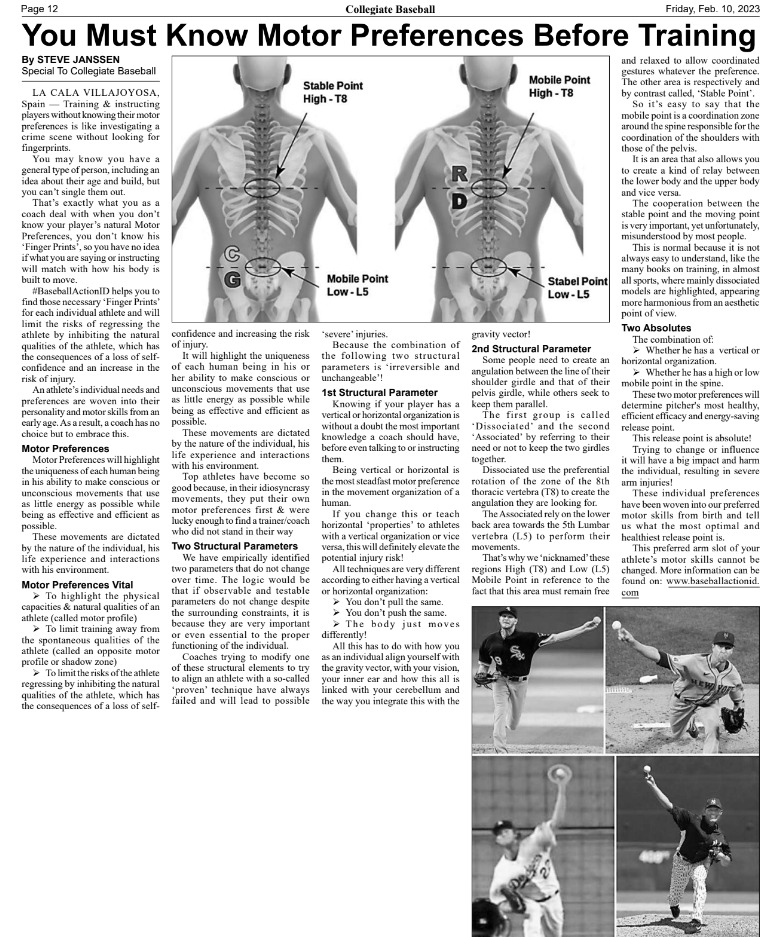
Every pitcher operates within a constrained release window determined by their motor organization.
This is not a style preference.
It is a structural reality shaped by:
- How the body organizes movement under gravity
- How rotation is distributed through the system
- How spinal coordination is stabilized
- How energy is sequenced through the delivery
Within that system, the “arm slot” is not a dial that can simply be adjusted.
It is an emergent expression of deeper organization.
Which means:
The same pitch requirement does not produce the same cost across different pitchers.
When pitch design leads the athlete
Modern pitch design often works in the following direction:
- The desired pitch shape is defined
- Release characteristics are inferred
- Mechanical adjustments are introduced
- The athlete adapts to the model of conformity
This is where friction begins.
Because the system is no longer asking:
“What can this pitcher produce?”
It is increasingly asking:
“Can this pitcher become compatible with this pitch output?”
And that question sounds harmless — until it is applied at scale.
Because when adaptation is forced upward from output to organization, something important gets lost:
Efficiency inside the athlete’s natural release window.
The arm slot problem
This is where MotorBall’s position must be precise.
There is no “universally optimal arm slot.”
But there is also no “completely fluid arm slot.”
Instead:
Each athlete has a constrained range of release solutions that emerge from their motor organization.
Within that range, movement is:
- More efficient
- More coordinated
- Less internally stressful
Outside of it, the system compensates.
And compensation rarely stays isolated.
It redistributes.
That is where inconsistency, velocity volatility, and breakdown patterns often emerge.
Not because mechanics are “wrong” — but because organization is mismatched with imposed output demands.
The pitch design paradox
Pitch design has created real progress in baseball.
Better understanding of movement.
Better decision-making.
Better pitch effectiveness.
But it also introduces a paradox:
The more precisely we define the pitch, the more pressure we place on the pitcher to reorganize himself around that definition.
And that is where performance and durability begin to diverge.
Because a pitch that is “optimal” in isolation is not necessarily optimal:
- For the athlete producing it
- For the release window, it requires
- Or for the long-term stability of the system executing it
The consequence layer (what this actually shows up as)
This is not a theoretical discussion.
In practice, misalignment between pitch design and motor organization tends to appear as:
- Inconsistent release quality
- Fluctuating command under fatigue
- Reduced repeatability in high-effort environments
- And increased structural stress across the delivery system
These outcomes are often treated separately.
But they are not separate problems.
They are expressions of the same underlying issue:
The athlete is operating outside his most stable release window.
And in modern baseball, this misalignment carries both performance and organizational costs.
Not as a headline number — but as accumulated system friction across development pipelines.
Reframing the core question
The key question is not:
- What is the best pitch shape?
- What is the optimal release?
- What is the ideal model output?
The key question is:
Can this pitch emerge from this athlete without violating his motor organization?
Because if the answer is no, the cost is not just a mechanical adjustment.
It is systemic adaptation.
And systemic adaptation always has a limit.
Closing — back to Pitch Tunneling, forward to execution reality
Pitch tunneling showed us that perception is not uniform across hitters.
Pitch design is showing us something parallel on the other side:
Execution is not uniform across pitchers.
Between those two lies a critical gap that modern baseball is still learning to navigate.
And that gap defines the next stage of development thinking:
The future advantage will not come from designing better pitches in isolation.
It will come from understanding which pitches can emerge from which athletes — without forcing them out of their natural release window.