THE FIRST LAW OF MOTORBALL: Movement Doesn’t Start With Movement
Why mechanics are the last thing the body produces—not the first
Last week, I argued that modern pitch design may be pushing some pitchers outside their healthiest release window.
Not because pitch design is inherently flawed.
Not because technology is the problem.
But because every pitcher operates within a natural range of movement solutions that emerges from how his body organizes movement.
That raises a deeper question.
If every pitcher has a natural release window…
Where does that window come from?
Most baseball conversations begin with movement.
Mechanics.
Arm action.
Release point.
Stride length.
Kinematic sequence.
Delivery.
Everything starts with what we can see.
But MotorBall starts somewhere else.
Because movement is not the beginning of movement.
It is the end of a much longer process.
And understanding that process may be the first law of MotorBall.
The Invisible Beginning
Imagine watching a pitcher throw a fastball.
You see the leg lift.
The hip rotation.
The arm path.
The release.
The follow-through.
It feels as though movement begins when the body starts moving.
It doesn’t.
Long before the arm accelerates…
Long before the front foot lands…
Long before the baseball leaves the hand…
Something else has already happened.
The athlete has already organized the task.
The body has already decided:
How to stabilize.
How to orient itself relative to gravity.
How to distribute tension.
How to sequence force.
How to prepare the movement that will eventually become visible.
By the time we observe mechanics…
Most of the important decisions have already been made.
Baseball Starts at the End
This is where modern player development quietly creates its biggest limitation.
Most development models begin here:
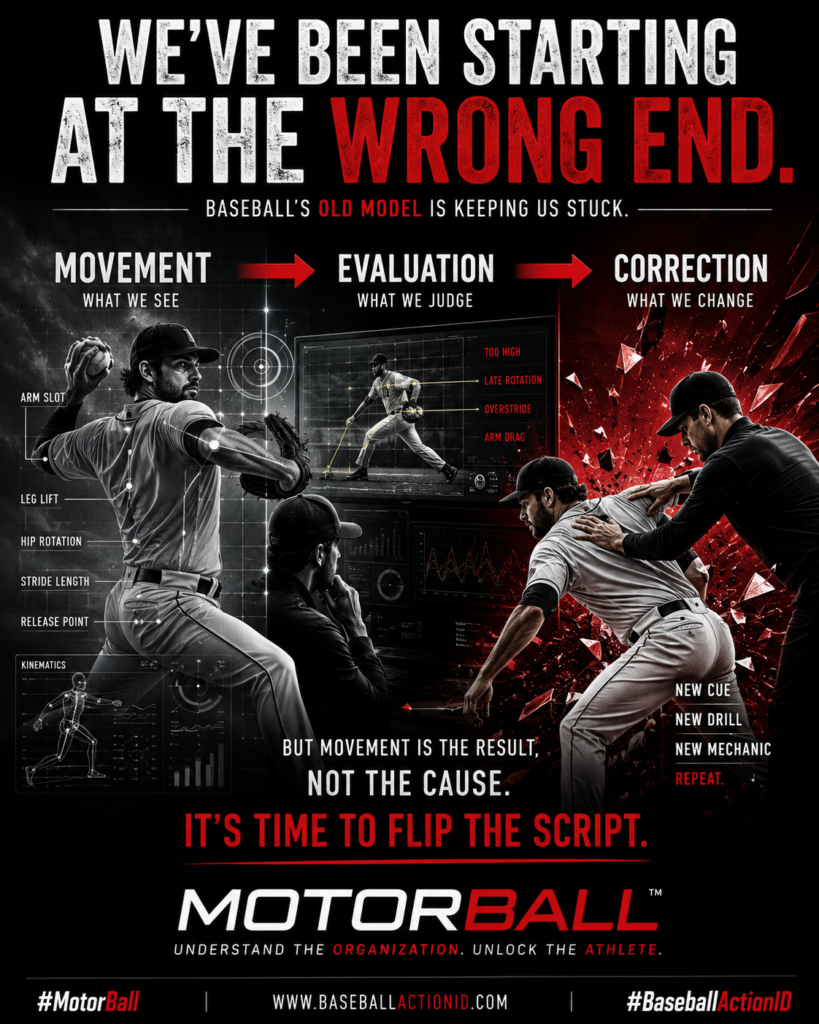
Movement → Evaluation → Correction
Watch the delivery.
Find the flaw.
Correct the mechanics.
Repeat.
Sometimes that works.
Sometimes it doesn’t.
MotorBall asks a different question.
What if mechanics are not the source of the problem?
What if they are simply the visible expression of something happening much deeper?
The First Law of MotorBall
Everything inside MotorBall begins with one principle:
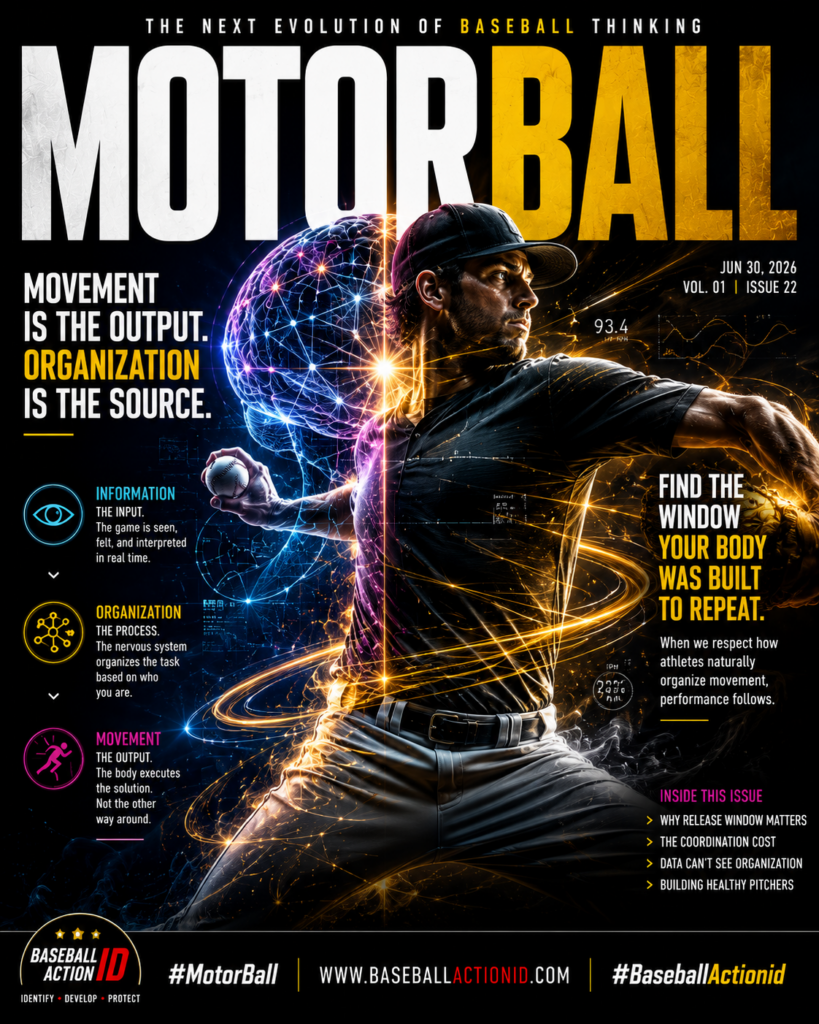
Information → Organization → Movement
Not:
Information → Movement
And not:
Mechanics → Performance
First, the athlete receives information.
Visual information.
Vestibular information.
Spatial information.
Task information.
Then…
The nervous system organizes that information according to the athlete’s natural coordination tendencies.
Only after that organization occurs…
Movement emerges.
Mechanics are therefore not the cause.
They are the consequence.
Why Two Athletes Can Look Similar… But Be Completely Different
This is why two pitchers can produce remarkably similar deliveries…
While solving the task in completely different ways.
The same arm slot.
The same release height.
The same velocity.
The same pitch shape.
Externally…
Almost identical.
Internally…
Entirely different organizational solutions.
And because baseball usually evaluates the visible layer…
Those differences often remain invisible.
Why Mechanical Changes Sometimes Work… And Sometimes Don’t
This also explains one of baseball’s oldest mysteries.
Why can the exact same coaching cue transform one pitcher…
While quietly derailing another?
If mechanics were the source…
That shouldn’t happen.
But mechanics aren’t the source.
Organization is.
One pitcher reorganizes naturally around the new cue.
Another must compensate.
From the outside…
Both appear to have made the same adjustment.
Inside the system…
They solved completely different problems.
The Release Window Is a Consequence—Not a Target
Last week, I argued that every pitcher has a natural release window.
That window is not something the athlete consciously chooses.
Nor is it simply an arm-slot preference.
It emerges from organization.
How the body coordinates gravity.
How force is sequenced.
How stability is created.
How movement is regulated under speed.
The release window is therefore not something we should arbitrarily manipulate.
It is something we should first understand.
Because once organization changes…
The release window changes with it.
What This Changes
This shifts the entire conversation.
Instead of asking:
“How do we improve this delivery?”
MotorBall first asks:
“How is this athlete organizing the task?”
Because until that question is answered…
Every mechanical intervention is, to some degree…
An educated guess.
Sometimes the guess is correct.
Sometimes it creates compensation.
Sometimes it quietly moves the athlete further away from the movement solution his nervous system naturally trusts.
The Future of Player Development Starts Earlier
Modern baseball has become remarkably good at describing movement.
Mechanics.
Pitch design.
Biomechanics.
Ball flight.
Kinematics.
But description is not the same as explanation.
Movement is not where human performance begins.
Organization is.
And once we begin looking there…
Many of baseball’s biggest mysteries become far less mysterious.
The future of player development may not depend on seeing movement more clearly.
It may depend on understanding what happens before movement ever begins.
Because that is where every delivery…
Every pitch…
Every swing…
And every athlete…
Actually starts.