The Biggest Draft Mistake Happens After Draft Day
Why good intentions aren’t enough to develop elite talent.

Every July, Major League Baseball organizations invest millions of dollars in the Draft.
Thousands of scouting reports are written.
Millions of data points are collected.
Pitch velocities are measured.
Spin rates are analyzed.
Biomechanical reports are reviewed.
Psychological evaluations are completed.
Medical histories are examined.
Every possible effort is made to identify the next great Major League player.
Yet every single year, baseball experiences the same frustrating reality.
Some late-round picks become All-Stars.
Some first-round picks never reach their projected ceiling.
Some elite prospects quietly disappear.
And some pitchers who once looked destined for Major League success are no longer in professional baseball only a few years later.
Baseball usually explains these stories the same way.
“He couldn’t adjust.”
“He never developed.”
“He got injured.”
“He didn’t live up to the expectations.”
But what if baseball has been asking the wrong question all along?
What if the biggest mistake isn’t made on Draft Day…
What if it happens afterward?
Baseball Doesn’t Have an Effort Problem
One thing is important to understand before we go any further.
The overwhelming majority of coaches in professional baseball genuinely want to help players.
Scouts work countless hours.
Pitching coaches care deeply.
Player development departments invest enormous amounts of time trying to help athletes improve.
Nobody wakes up in the morning trying to ruin a pitcher.
Nobody intentionally pushes a player toward injury.
Nobody designs a development program hoping an athlete will fail.
The intentions are almost always good.
Very good.
This makes the following question even more important.
If everyone is trying to help…
Why do so many players still move further away from their potential instead of closer to it?
The Assumption Nobody Questions
Player development begins long before the first bullpen.
Long before the first mechanical adjustment.
Long before pitch design.
It begins with a decision.
Usually an invisible one.
What kind of athlete are we looking at?
That single assumption quietly shapes everything that follows.
How do coaches interpret movement?
How do they evaluate mechanics?
How do they design pitches?
How they build strength programs.
How do they choose drills?
How do they define improvement?
Every intervention grows from that initial understanding of the athlete.
And that raises an uncomfortable possibility.
What happens if the starting point is incomplete?
A Story I Shared Earlier This Year
Several months ago, I wrote about a professional pitcher who once threw 98 mph.
He possessed elite velocity.
Professional organizations believed in his talent.
His future looked incredibly promising.
A few years later…
He was released.
The easy explanation would have been to say he simply wasn’t good enough.
But that wasn’t the story.
His work ethic hadn’t disappeared.
His competitiveness hadn’t disappeared.
His commitment hadn’t disappeared.
Instead, something much more subtle happened.
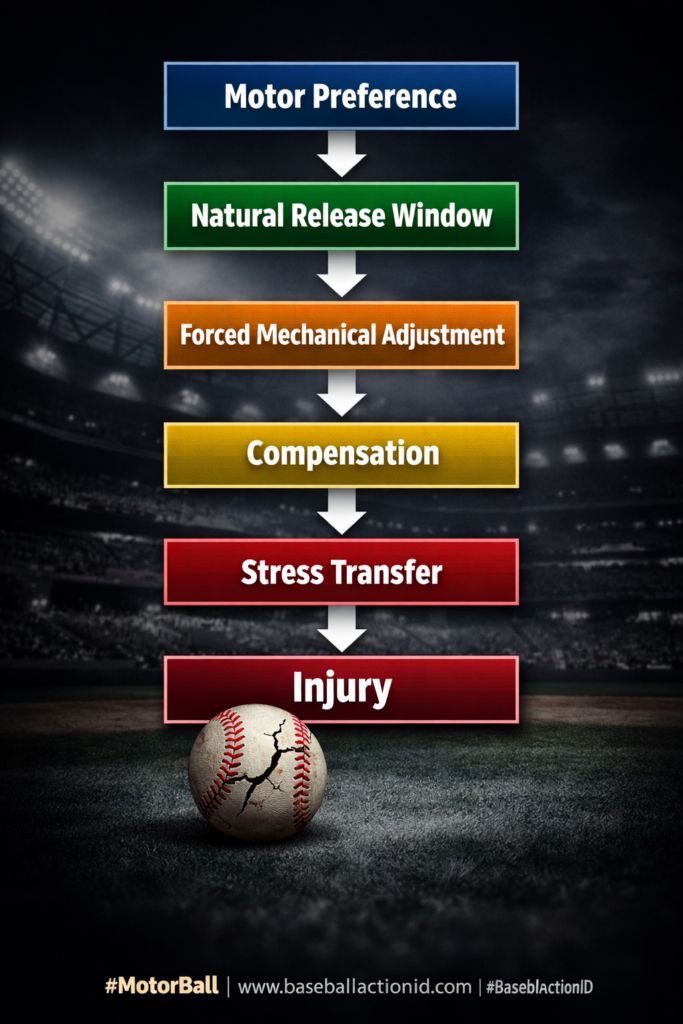
Over time, the way he was being developed moved him further and further away from the natural movement organization that had originally allowed him to perform at such a high level.
Nothing dramatic happened overnight.
No single coaching cue destroyed his career.
No individual drill caused the outcome.
It was the accumulation of well-intentioned interventions, each designed to improve performance, that gradually pulled the athlete away from the movement solutions his nervous system naturally trusted.
Eventually, the performance that once made him special became increasingly difficult to reproduce.
It Was Never About One Pitcher
That story resonated with many readers.
Not because it was unique.
But because almost every coach has seen a version of it.
A pitcher arrives with exceptional qualities.
Development begins.
Changes are introduced.
Some improvements appear immediately.
Others don’t.
Months later…
The athlete somehow looks less natural than before.
Nobody intended that outcome.
Everyone involved was trying to help.
Which brings us to an uncomfortable realization.
Perhaps baseball’s greatest developmental failures are not created by bad coaching.
Perhaps they are created by good coaching built upon incomplete assumptions.
Good Intentions Are Not the Same as Good Development
Earlier this year, I also shared another story titled “When Good Intentions Break a Pitcher.”
The message wasn’t that coaches don’t care.
The message wasn’t that organizations don’t invest enough.
The message certainly wasn’t that mechanical coaching should disappear.
The point was much simpler.
Good intentions cannot compensate for starting from the wrong developmental model.
If the foundation is incomplete…
Every improvement built upon that foundation becomes increasingly uncertain.
The better the execution…
The further an athlete may actually move away from the movement organization that made him successful in the first place.
That idea makes many people uncomfortable.
But discomfort doesn’t automatically make something incorrect.
Sometimes it simply means we’ve reached the limits of our current explanation.
The Draft Doesn’t End With Talent Identification
Baseball often treats the Draft as a talent acquisition process.
MotorBall views it differently.
The Draft is the beginning of a relationship between an athlete and a development system.
From that moment forward, every decision matters.
Every cue.
Every drill.
Every mechanical adjustment.
Every pitch design intervention.
Every strength program.
Every attempt to “clean up” movement.
Every effort to improve performance.
The question is no longer:
“Did we draft the right player?”
The more important question becomes:
“Do we actually understand the athlete we just drafted?”