What MLB Staff Told Me When I Asked the Hard Question

A few weeks ago, I reached out to several people inside MLB and college baseball —
coaches, performance directors, and player developers — and asked one simple question:
“If we could change just one thing in how we train or develop players, what
would have the biggest real-world impact?”
The responses were fascinating — and incredibly insightful.
Hearing directly from those who live and breathe the daily realities of player development
gave me a clearer picture of what’s truly happening on the ground — and what challenges
keep surfacing behind the scenes.
What stood out most wasn’t just what they said, but the tone: there’s a shared sense of
curiosity and urgency.
Everyone feels that baseball is at a crossroads.
That conversation became the spark for this new series.
Each part will explore a topic brought up by coaches inside the system — and answer it
through the lens of Motor Preferences, the foundation of #MotorBall and
#BaseballActionID.
This first part addresses one of the most frequently mentioned issues:
“The lack of conditioning and the drop in aerobic capacity that limits
recovery.”

Part 1: The Real Conditioning Gap in Baseball
When coaches talk about “conditioning,” most conversations quickly turn toward gym work
— lifts, mobility drills, or sprint mechanics.
But true conditioning goes far beyond that.
Conditioning isn’t only about how strong a player is; it’s about how efficiently their
system manages load, recovers, and repeats high-quality movement under stress.
From a #MotorBall standpoint — built on the ActionTypes principles — this goes much
deeper than sets, reps, or VO₂ max.
It’s about the nervous system’s preferred way of organising movement, and how that
preference dictates the most effective (and safest) form of conditioning for each player.
Why Aerobic Capacity Alone Doesn’t Explain Recovery
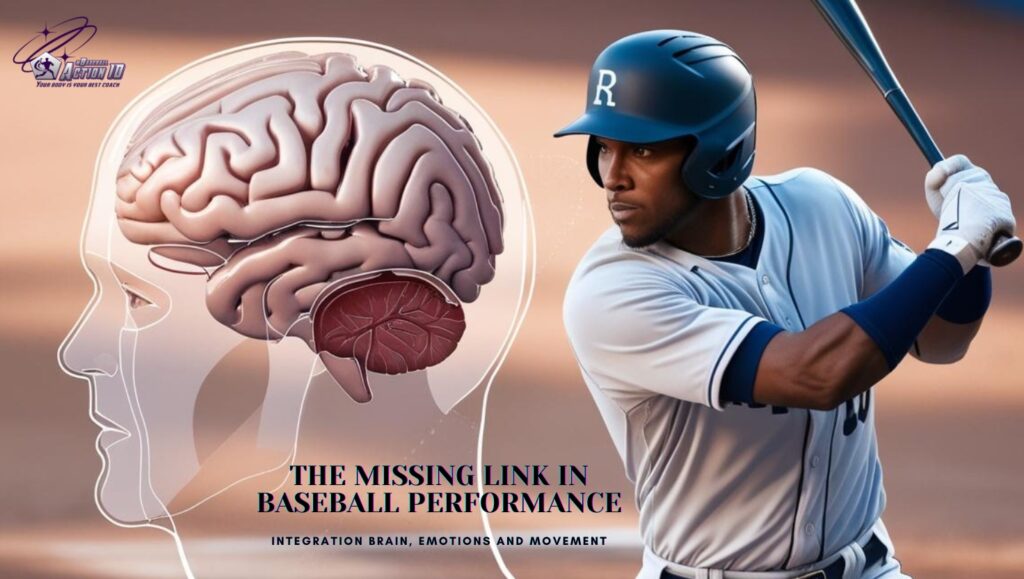
Low aerobic capacity isn’t the full story.
Two athletes can show identical aerobic test results — yet one recovers fast, while the other
fades after two innings.
Why?
Because recovery efficiency depends not only on oxygen transport, but also on how
the athlete’s motor system processes fatigue and resets coordination.
Every player belongs to a motor family — Global, Distal, Conceptual, or Rhythmical —
which shapes how they produce and recycle energy.
That’s why some players seem to recover best while moving, while others need total
stillness to recharge.
In other words: Conditioning is not universal.
It’s not about “who runs the most poles,” but about what type of motion or rhythm restores
that player’s system.
What the Modern Game Missed
Baseball’s shift toward power metrics and high-intensity gym work created a massive blind
spot.
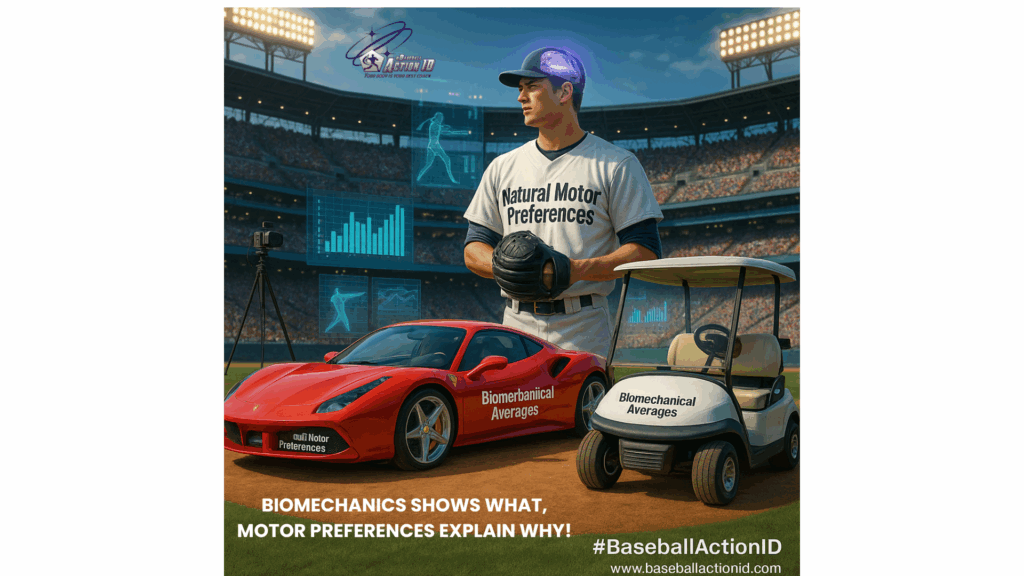
The focus moved toward output — velocity, torque, explosiveness — but the system’s ability
to sustain and recover from that output fell behind.
We’ve conditioned athletes to peak explosively but recover poorly.
And ironically, the more “mechanically perfect” and force-driven our models have become,
the further we’ve drifted from what the human body actually needs to stay adaptable,
rhythmic, and coordinated under fatigue.
The result?
A generation of athletes who look fit — but whose systems are not conditioned to manage
the invisible load of baseball: the mental rhythm, the coordination demands, the motor flow.
The #MotorBall Answer
From a Motor Preferences perspective, conditioning starts with understanding how the
athlete’s system builds and regulates energy.
Some players naturally need to create rhythm through cyclical, continuous movement,
while others perform better with short, segmented bursts followed by reset periods.
For one athlete, too much static work or forced symmetry breaks their flow;
For another, it provides essential grounding and control.
The same logic applies internally:
Some athletes need to train their abdominals dynamically and their obliques
isometrically,
while others require the exact opposite.
The exercise might look identical from the outside — but from the inside, the neurological
demand and recovery effect are completely different.
That’s the essence of #MotorBall:
Conditioning isn’t about what looks hard — it’s about what connects the athlete’s natural
motor system.
Because once that system is in sync, power, endurance, and recovery all rise together —
without fighting the body’s design.
The Takeaway
Baseball doesn’t need more “conditioning sessions.”
It needs smarter conditioning systems — ones that respect how each player’s body is
wired to produce, absorb, and restore energy.
True conditioning happens when movement, recovery, and motor preference are aligned.
That’s when we stop training muscles — and start training the athlete’s system.
Closing
This is just the beginning of the conversation.
Each of the topics MLB and college coaches shared will be explored through this same lens
— translating the science of ActionTypes and the reality of on-field performance into a
model that makes sense where it matters most:
Between the lines.