The Most Valuable Prospect Isn’t Always the Highest-Ranked Prospect
Why baseball may still be asking the wrong question at the Trade Deadline.
Just a few days ago, I published an article titled:
“The Biggest Draft Mistake Happens After Draft Day.”
Its central idea was simple.
Baseball invests extraordinary resources in identifying talent.
Far less attention is given to whether that talent is developed in a way that actually fits the athlete.
Now, only days later, the conversation across Major League Baseball has already shifted.
The Draft is over.
The Trade Deadline is approaching.
Front offices are no longer asking,
“Who should we draft?”
They’re asking,
“Who should we trade for?”
Different question.
Different timing.
The same blind spot.
The Draft identifies talent.
The Trade Deadline redistributes it.
Neither guarantees an organization actually knows how to unlock it.
Every Prospect Has a Price
This time of year, baseball becomes obsessed with prospect value.
Who’s untouchable?
Who’s available?
Who’s worth a Top-100 prospect?
Who’s overvalued?
Who’s the centerpiece of the deal?
Every organization studies the same information.
Velocity.
Stuff.
Command.
Age.
Projection.
Medical reports.
Future Value grades.
Years of club control.
Millions of dollars are invested trying to answer one question.
How valuable is this player?
But there’s another question almost nobody asks.
How valuable is this player inside our organization?
That may be the more important one.
Baseball Treats Talent Like It’s Universal
Prospect rankings are incredibly valuable.
Scouts do extraordinary work.
Analytics departments process more information than ever before.
None of that is the problem.
The hidden assumption is.
Every ranking quietly suggests that talent has an objective value.
That a No. 15 prospect is simply more valuable than a No. 65 prospect.
Regardless of who acquires him.
Regardless of how he’s coached.
Regardless of how he’s developed.
But history keeps telling us something different.
Every season…
Top prospects disappear.
Late-round picks become stars.
Organizations “win” trades nobody understood at the time.
Baseball often calls these stories surprises.
Maybe they aren’t.
Same Prospect. Different Future.
Imagine two organizations evaluating exactly the same pitcher.
Same velocity.
Same pitch shapes.
Same athleticism.
Same TrackMan report.
Same medical history.
Same prospect ranking.
Organization A sees a future frontline starter.
Organization B sees a future middle reliever.
Five years later…
Organization A has developed an All-Star.
Organization B would’ve probably released him.
What changed?
Not the arm.
Not the talent.
Not the work ethic.
The environment.
We’ve Seen This Story Before
Earlier this year, I shared the story of a professional pitcher who once threw 98 mph.
Organizations believed in his talent.
His future looked bright.
A few years later…
he was out of affiliated baseball.
The easy explanation was that he didn’t develop.
I don’t believe that’s what happened.
His work ethic didn’t disappear.
His competitiveness didn’t disappear.
His commitment didn’t disappear.
What gradually disappeared was something much harder to recognize.
Over time, the development process slowly moved him further away from the movement organization that had originally allowed him to become exceptional.
No single coach caused it.
No single drill caused it.
No single mechanical adjustment caused it.
It was the accumulation of well-intentioned decisions, each trying to improve the athlete, that gradually took him further away from the movement solutions his nervous system naturally trusted.
Eventually…
The player organizations drafted no longer existed.
Not because the talent disappeared.
Because access to it did.
Good Organizations Can Still Miss Great Players
A few months later, I wrote another article:
“When Good Intentions Break a Pitcher.”
The point wasn’t to criticize coaches.
Quite the opposite.
Most coaches genuinely care.
Most organizations invest enormous resources into player development.
The uncomfortable truth is simply this.
Good intentions do not automatically produce good development.
If the starting point is incomplete…
Better execution doesn’t necessarily create better outcomes.
Sometimes it simply accelerates the athlete in the wrong direction.
That’s not a coaching problem.
It’s a developmental model problem.
The Trade Deadline Changes the Conversation…
…But Not the Assumption.
Buying organizations ask:
“Can this player help us win now?”
Selling organizations ask:
“Which prospects should we acquire?”
Different questions.
Same assumption.
That prospect value lives inside the player.
MotorBall asks something different.
What if part of a prospect’s value actually lives inside the organization that acquires him?
Now the conversation changes completely.
Organizations Don’t Develop Every Player Equally
This may be the hardest truth to accept.
Organizations don’t simply develop players.
They develop certain players exceptionally well.
Every organization has a philosophy.
Every organization has preferred teaching methods.
Preferred movement models.
Preferred pitch-design strategies.
Preferred mechanical solutions.
Preferred communication styles.
Preferred ways of solving problems.
Those philosophies create tremendous success…
For certain athletes.
For others…
They quietly create friction.
Not because anyone is doing something wrong.
Because development is never one-size-fits-all.
The same coaching environment that unlocks one pitcher may slowly disconnect another from the movement organization that made him successful in the first place.
That’s why talent alone never tells the entire story.
The Hidden Variable Nobody Trades For
At the Trade Deadline, organizations negotiate for prospects.
But perhaps they’re actually negotiating for something else.
Compatibility.
Not just between the player and the roster.
Between the player and the developmental ecosystem.
Can our coaches recognize what this athlete naturally does?
Can our player development department build around his organization instead of replacing it?
Can our pitch design process amplify his strengths without disrupting the movement solutions that already make him unique?
If the answer is no…
How valuable is that prospect really?
The Future of Roster Construction
A few weeks ago, I wrote another article:
“The Future GM Won’t Ask ‘Can He Coach?’ He’ll Ask ‘Who Can He Coach?’”
Perhaps the same evolution is coming to roster construction.
Maybe the future question won’t be:
“Who’s the best prospect?”
Maybe it becomes:
“Which prospect fits the way our organization actually develops athletes?”
That’s an entirely different scouting philosophy.
And perhaps…
An entirely different competitive advantage.
A Different Definition of Value
Imagine two prospects.
One ranks No. 18.
The other ranks No. 86.
Traditional baseball asks:
“Who’s better?”
MotorBall asks:
“Better… for whom?”
That’s not semantics.
That’s strategy.
Because prospect value isn’t absolute.
It’s contextual.
It depends on whether the athlete enters an environment capable of understanding how he naturally organizes movement.
The organization doesn’t simply inherit the player’s talent.
It inherits the responsibility of either unlocking it…
Or unintentionally moving him further away from it.
Before You Rank the Prospect…
Every Trade Deadline produces winners.
Every Trade Deadline produces losers.
Years later…
Many of those verdicts look completely different.
Maybe that shouldn’t surprise us anymore.
Because perhaps the most valuable prospect…
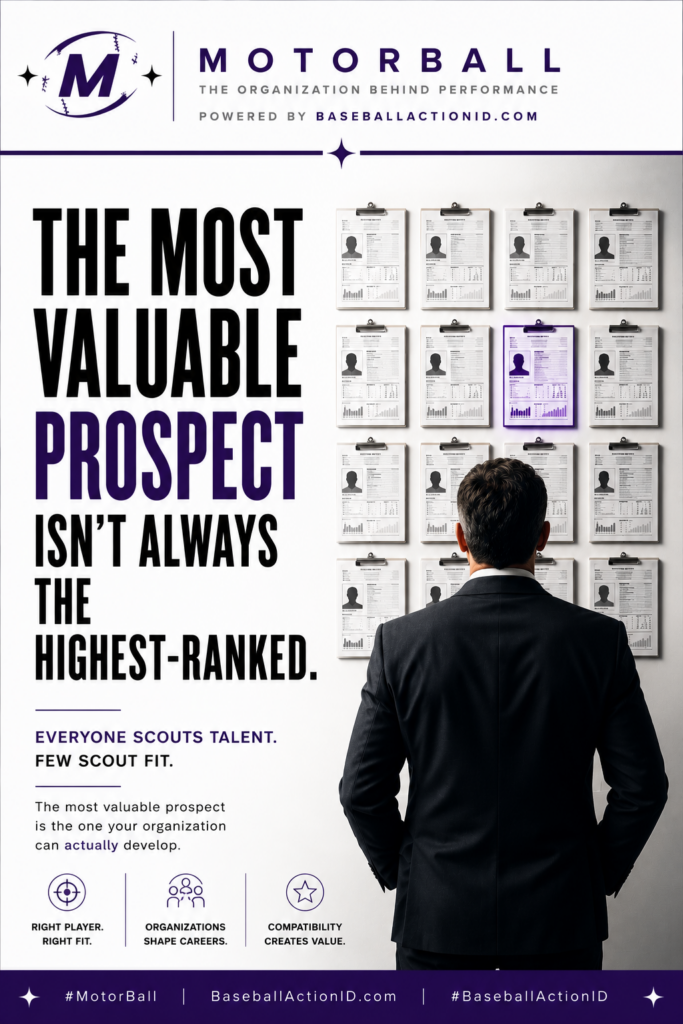
Isn’t always the highest-ranked prospect.
It’s the prospect whose natural movement organization finally meets an organization capable of recognizing it, respecting it, and building upon it.
Before baseball asks:
“How valuable is this prospect?”
perhaps it should first ask,
“How valuable is this prospect inside our organization?”
Because talent doesn’t develop in isolation.
Neither do athletes.
And perhaps the next competitive advantage in Major League Baseball won’t come from finding better prospects.
It will come from finally understanding which prospects your organization is actually built to develop.