
Pitch Tunneling in Baseball: What If It’s Not Universally Effective?
Its effectiveness depends on how hitters organize visual information
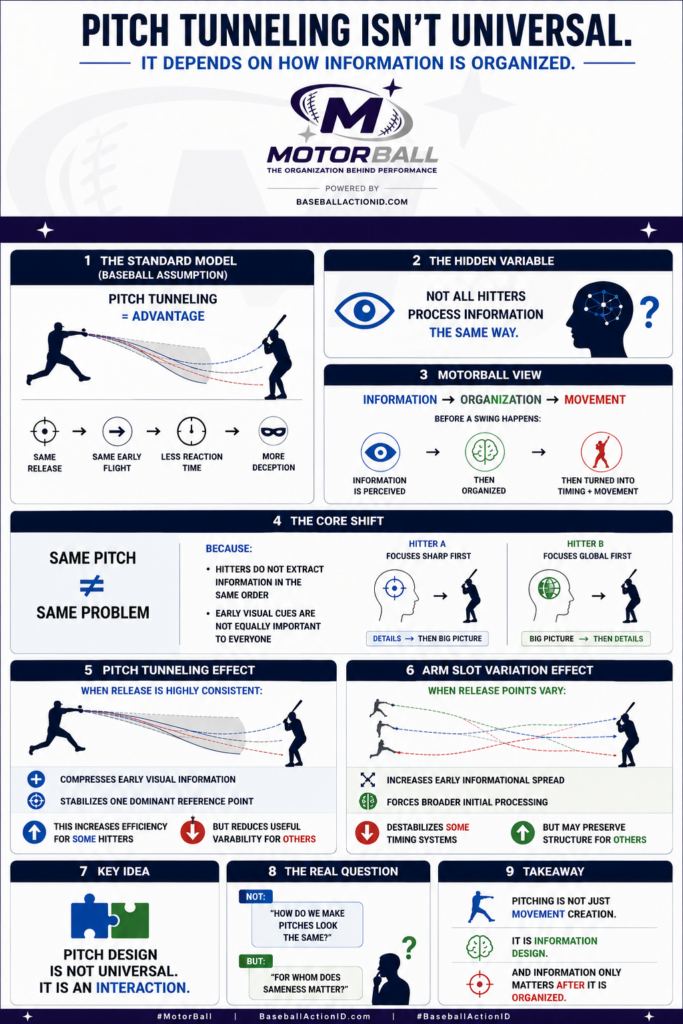
In the previous article, I argued that the future of baseball may not belong to organizations that hire great coaches.
It may belong to organizations that understand which athletes those coaches are naturally built to help.
Because once coaching stops being universal…
something uncomfortable happens.
You realize that many of baseball’s biggest ideas may not be universal either.
Pitch design.
Player development.
Mechanical models.
And maybe one of the most accepted concepts in modern pitching deserves the same question.
Pitch tunneling.
Baseball often treats pitch tunneling as an absolute advantage.
A better tunnel.
More deception.
Less reaction time.
Better outcomes.
But what if that assumption quietly depends on something nobody measures?
Not the pitch.
The hitter.
Because if players organize information differently…
Then the same pitch may not create the same effect.
And suddenly the question changes.
Not:
“How do we create better tunnels?”
But:
“For whom do tunnels actually work?”
One of the most accepted ideas in modern baseball is simple:
If pitches look the same out of the hand, hitters are more likely to miss.
Pitch tunneling has become a core principle in modern pitch design because it makes intuitive sense.
Same release.
Same early trajectory.
Less time to react.
More deception.
But there is a question hidden inside that assumption that almost nobody asks:
What if this is not universally true?
What if pitch tunneling does not create the same effect on every hitter?
Not because the pitches change.
But because the hitter does.
The Unspoken Assumption in Pitch Design
Modern pitching theory often starts from movement:
How do we make pitches look identical for as long as possible?
How do we reduce early cues?
How do we force late decisions?
But underneath that sits a quieter assumption:
That all hitters process early visual information in the same way.
MotorBall starts one layer earlier.
Information → Organization → Movement
Before a hitter swings, information must be perceived.
Before a decision exists, that information must be organized.
Movement is the result of that process — not the starting point.
The Same Pitch Is Not the Same Problem
Take two hitters facing the same pitch:
Same velocity.
Same release point.
Same tunnel.
Baseball treats this as equal information.
But in reality, the pitch is only identical on the surface.
Because what matters is not what is thrown…
But how it is organized once it is seen.
Some hitters appear to stabilize timing when early cues are consistent and compressed.
Others appear to stabilize timing when early cues are broader and less predictable, allowing more global orientation before refinement.
Neither is better in general.
But they are not responding to the same thing.
Why Pitch Tunneling Works So Well (and Sometimes Doesn’t)
Pitch tunneling reduces early differentiation between pitches.
Fastball and breaking ball share a common visual path before separation.
For many hitters, this creates a clean early anchor point — a stable reference that allows fast commitment.
But in other cases, that same stability removes variation in early information that certain hitters may unconsciously use to build their timing structure.
So the same tunnel can do two different things:
- Compress the decision space for one hitter
- Remove useful orientation cues for another
The pitch does not change.
The informational effect does.
Now Flip the System
What happens when pitchers introduce more variation instead?
Different arm slots.
Different release heights.
Different visual entry angles.
Now the hitter is no longer dealing with a single consistent informational path.
For some hitters, this increases noise and delays stabilization.
For others, it may actually preserve usable structure longer because the brain shifts into broader contextual processing earlier.
Variation is not simply the opposite of tunneling.
It is a different type of informational demand.
The Real Question Isn’t Tunneling
The real question is not:
“How do we make pitches look the same?”
The real question is:
For whom does that sameness matter most?
Because if hitters do not extract information in the same order…
Then, pitch design cannot produce universal effects.
A Simple Way to Think About It
Pitch tunneling is often treated as a weapon.
Arm-slot variation is often treated as unpredictability.
But both are only meaningful after one thing happens:
The hitter organizes what he sees.
And that organization is not uniform.
Which means the same pitch design strategy may not scale equally across all hitters.
What This Changes
If this is true, then pitching and hitting development may be missing something fundamental:
Not just how pitches move.
Not just how swings are built.
But how information is structured before movement happens.
Because once information is organized differently…
Timing changes.
Decision-making changes.
Movement changes.
Not because the pitch changed.
But because the perception did.
Final Thought
Pitch tunneling is not the story.
It is part of the story.
The real question is whether baseball has been treating an interaction effect as if it were a universal one.
And if that is true…
Then the edge is not in throwing better tunnels.
It is in understanding who is standing in them.