PRONATORS, SUPINATORS & PITCHING
When a release pattern becomes a label — and the label becomes an explanation.

MEASURING IS KNOWING. IS IT?
In my previous article, “MEASURING IS KNOWING — Is it?”, I asked a simple question:
What does a measurement actually allow us to know?
This article takes that question onto the pitching mound.
Because few examples expose the difference between measuring movement and understanding movement better than the way we increasingly talk about pronators and supinators.
And last offseason, I had a conversation with an elite-level MLB starting pitcher that brought that question very close to home.
He was certain he knew the answer.
Until we profiled him.
“I’M A PRONATOR.”
That was his answer.
I was in contact with an elite-level MLB starting pitcher last offseason when the subject of pronation and supination came up.
At one point, he told me:
“I’m a pronator.”
I asked him:
“Are you sure?”
“Yes.”
So I asked:
“Why are you so sure?”
His answer was immediate:
“TrackMan confirmed it.”
He also told me that the pitching lab within his organization had reached the same conclusion.
So I asked him one more time:
“And what if I told you that I believe you are actually a supinator?”
He strongly disagreed.
TrackMan said pronator.
The pitching lab said pronator.
Therefore, in his mind, he was a pronator.
Until I profiled him.
Within the Motor Signature framework, his organization showed something very different.
Supinating.
His reaction was disbelief.
Because now there was a contradiction.
Not necessarily between the technology and the profile.
But between what had been measured and what that measurement had come to mean about him.
Eventually, he asked the question that sits at the center of this entire article:
“Then why does my TrackMan data say I’m a pronator?”
Exactly.
Why?
THIS IS NOT REALLY ABOUT PRONATION AND SUPINATION
Pronation and supination are real.
Forearm rotation is real.
The measurements are real.
The data is real.
The question is what we do with that information.
We can measure what happens around release.
We can measure spin.
We can measure spin efficiency.
We can observe the relationship between the hand, the ball and the release.
We can identify recurring movement patterns.
And we can give those patterns a name:
Pronator.
Supinator.
There is nothing inherently wrong with that.
The problem begins when the label quietly becomes something much bigger.
Observed behavior → natural preference
Then:
Natural preference → pitcher identity
And eventually:
Pitcher identity → development strategy
That is a much bigger claim.
And it is the claim I believe we need to examine more carefully.
WHAT ARE WE ACTUALLY MEASURING?
Imagine we measure a pitch and see a particular rotational profile.
What do we know?
We know something about the movement that occurred.
We may know something about the ball.
We may know something about the release.
We may know something about the resulting pitch.
But do we automatically know that this is the pitcher’s natural Motor Signature?
That is a completely different question.
Have we established that the movement:
- Existed before years of pitching development?
- Is stable across different tasks?
- Is independent of pitch intent?
- Is independent of grip?
- Is independent of coaching?
- Is independent of imitation?
- Is independent of pitch-design intervention?
- Is independent of physical limitations?
- Is independent of fatigue?
- Is independent of compensation?
Or are we simply measuring what the athlete’s entire movement system currently produces?
Those are not necessarily the same thing.
A RELEASE IS A MOMENT
A pitcher does not arrive at release from nowhere.
He arrives there through an entire movement.
Years of learning.
Thousands of repetitions.
Coaching.
Drills.
Mechanical cues.
Imitation.
Pitch design.
Pitch intent.
Grip changes.
Physical development.
Adaptation.
Fatigue.
Injury history.
Compensation.
Technology.
And time.
All of these can influence what an athlete eventually produces.
So when we measure the movement today, what exactly are we seeing?
The athlete’s natural organization?
Or the accumulated result of everything that has happened along the way?
That distinction matters.
Because:
We can measure the movement accurately without measuring its history.
And perhaps one of the most important questions in this entire discussion is:
Was that actually his natural organization in the first place?
CONSISTENCY DOES NOT PROVE ORIGIN
This is where the discussion becomes particularly interesting.
Imagine a young pitcher is taught to create a certain fastball shape.
He changes his grip.
He changes his intent.
He changes how he organizes the movement.
He repeats it.
Again.
And again.
And again.
Eventually, the movement becomes highly repeatable.
Years later, a measurement system sees the same pattern over and over.
The pattern is consistent.
But what has actually been established?
That the behavior is consistent.
Not necessarily where it came from.
Consistency does not prove origin.
A learned solution can become a stable solution.
A stable solution can look natural.
And something that looks natural can then be treated as an identity.
That is where we need to be careful.
THE FOREARM IS NOT THE STARTING POINT
This is the distinction that matters most to me.
Pronation and supination are not arm-level identities.
They are expressions of how the entire body organizes movement.
The forearm may be where we see the expression.
It is not necessarily where the organization begins.
A pitcher does not have an isolated “pronator arm” or “supinator arm” operating independently from the rest of his movement.
The feet, legs, pelvis, trunk, shoulders, arm and forearm participate in one continuously interacting movement system.
And how that system is organized is individual.
That is where Motor Signature becomes important.
Not as another label.
Not as another bucket.
But as an organizing layer.
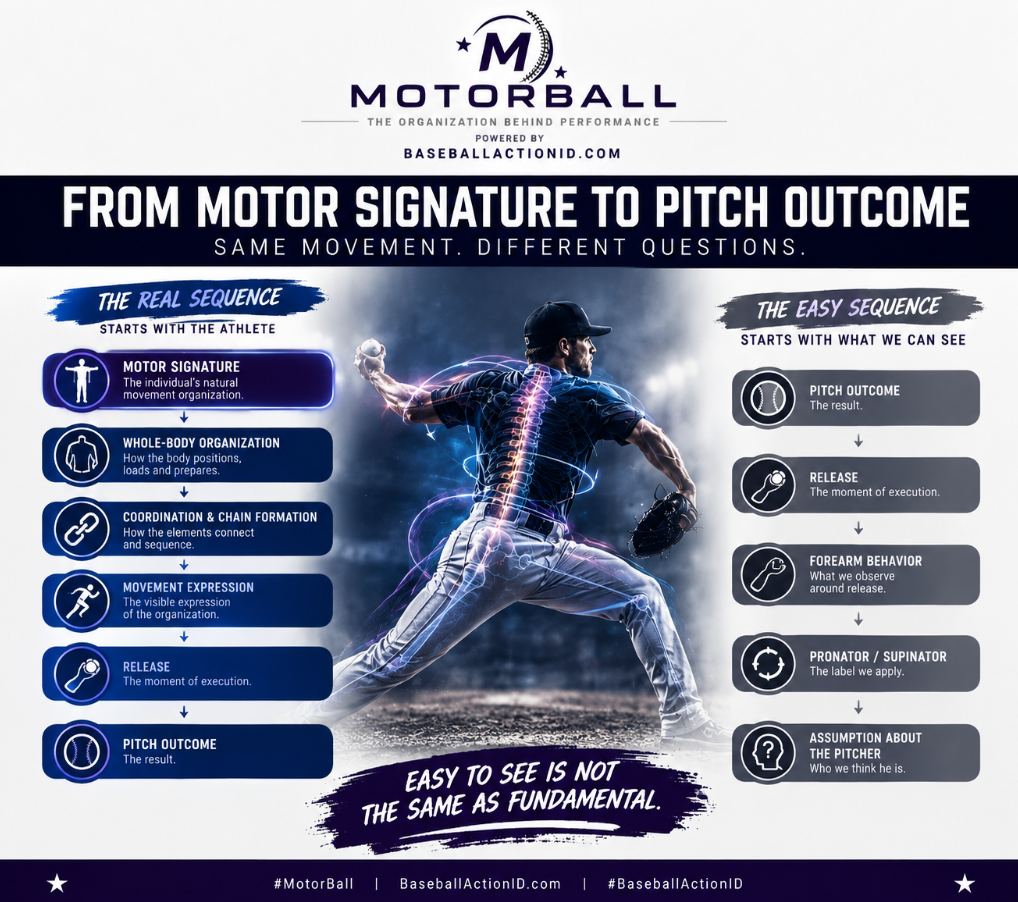
FROM MOTOR SIGNATURE TO PITCH OUTCOME
Think about the sequence differently.
Motor Signature
↓
Whole-body organization
↓
Coordination & chain formation
↓
Movement expression
↓
Release
↓
Pitch outcome
Now compare that with the direction we can easily fall into when we start with what is easiest to measure:
Pitch outcome
↓
Release
↓
Forearm behavior
↓
Pronator / Supinator
↓
Assumption about the pitcher
The second direction is attractive because the final pieces are visible.
They are measurable.
They can be compared.
They can be categorized.
But:
Easy to see is not the same as fundamental.
BACK TO THE MLB PITCHER
So let’s go back to that elite MLB starter.
Was TrackMan wrong?
That is actually not the question I would ask.
Was the pitching lab wrong?
Again, that is not the most interesting question.
The better question is:
Were they answering the same question?
TrackMan was giving us measurable information about what the pitcher was producing.
The lab was interpreting that information within its framework.
The Motor Signature profile was addressing something different:
How does this individual naturally organize movement?
Those questions can be related.
But they are not identical.
And that distinction changes everything.
Because the issue was not necessarily the measurement.
It was the meaning attached to the measurement.
THE DATA CAN REINFORCE THE STORY
Now consider what can happen next.
Measure
↓
Classify the pitcher as a pronator
↓
Design pitches around that classification
↓
Coach those pitches
↓
The athlete adapts
↓
Measure again
↓
The behavior still looks “pronator”
↓
The original interpretation appears confirmed
But what exactly has been confirmed?
The athlete’s original natural organization?
Or the stability of the solution after intervention?
Those are not the same thing.
This is not an argument against development.
Development is intervention.
It is an argument for being precise about what we call natural.
A MOVEMENT IS NOT AN IDENTITY
This is where I believe the conversation needs to move.
A pitcher can display a particular forearm behavior.
That behavior can be measured.
The measurement can be highly accurate.
The behavior can be highly repeatable.
And the classification can still tell us less about the athlete than we think.
Because:
A movement is not an identity.
A position is not an explanation.
A measured behavior is not automatically a Motor Signature.
That last distinction may be the most important one.
THIS CHANGES HOW WE LOOK AT PITCH DEVELOPMENT
If a pitcher presents with a particular spin profile, the traditional question might be:
“Is he a pronator or a supinator?”
Then:
“Which pitches fit that profile?”
A Motor Signature-informed approach starts earlier.
“What is this individual organizing naturally?”
Then:
“What does that organization produce?”
And then:
“Which pitch solutions fit the individual — rather than forcing the individual to fit the pitch?”
That is a different development philosophy.
It does not reject the data.
It gives the data context.
WE DON’T NEED LESS MEASUREMENT
I don’t want less technology.
I don’t want less biomechanics.
I don’t want less TrackMan.
I don’t want less motion capture.
And I don’t want less pitch design.
I want better interpretation.
Baseball has become extraordinarily good at collecting information.
The opportunity now is to become equally sophisticated at understanding what that information actually means.
Because the number can be correct.
The measurement can be correct.
The release can be real.
And we can still misunderstand the player.
Not because the measurement failed.
Because we misunderstood what it meant.
SO, ARE YOU REALLY A PRONATOR?
Maybe.
Maybe you’re a supinator.
Maybe your current movement expresses something that resembles one of those classifications.
But before we turn that observation into an identity, there is a more important question:
Is this what the athlete naturally organizes — or is this what years of development have taught him to produce?
Because those are not the same question.
And that is why I keep coming back to the same distinction:
Measure the movement.
Understand the organization.
Then interpret the outcome.
The forearm matters.
The release matters.
The pitch matters.
The data matters.
But none of those exist independently from the individual producing them.
The forearm is where we may see the expression.
The organization belongs to the whole person.
So perhaps the real question was never simply:
“Pronator or supinator?”
Perhaps the better question is:
What are we actually measuring — and what does that measurement allow us to know about the pitcher producing it?
Because a release is a moment.
A Motor Signature is an organization.
WHAT ARE WE ACTUALLY MEASURING?