
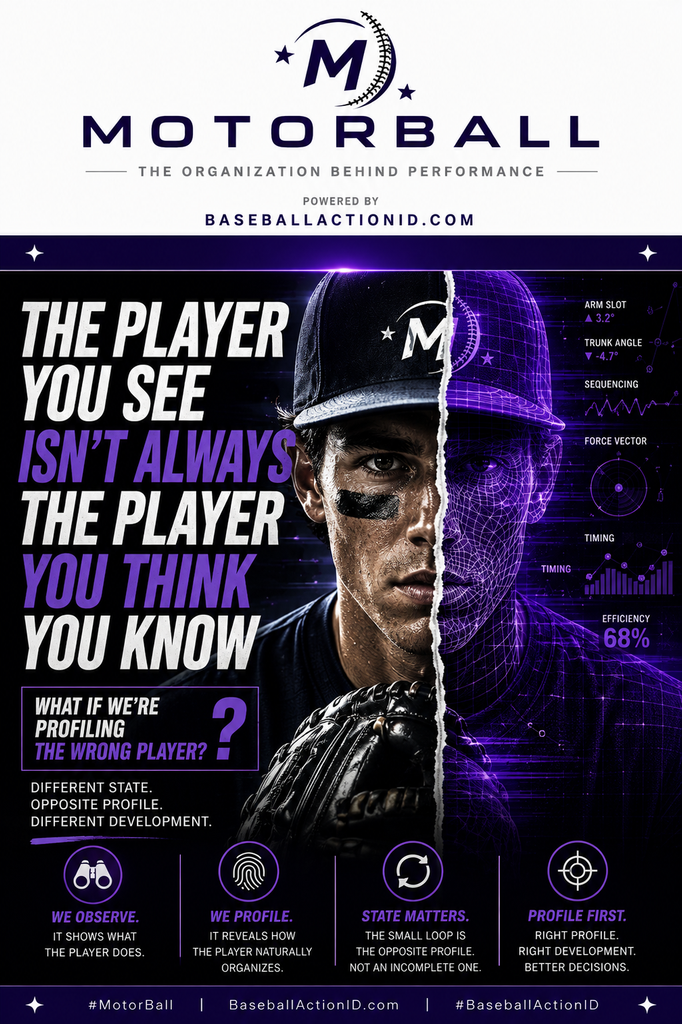
THE PLAYER YOU SEE ISN’T ALWAYS THE PLAYER YOU THINK YOU KNOW
What If The Biggest Mistake Happens Before The Intervention?
Last Week, I Wrote About A Phrase That Sounds Almost Harmless In Baseball:
“It’s Worth A Shot.”
Let’s Try It.
Maybe It Works.
Maybe It Doesn’t.
It Sounds Reasonable.
Player Development Is Full Of Uncertainty.
Coaches Experiment.
Players Adapt.
Organizations Test Ideas.
But There Was A Question Underneath That Phrase That I Think Deserves Much More Attention:
Worth The Shot Based On What?
Because There Is A Difference Between Experimenting With An Informed Hypothesis…
And Simply Taking A Shot Because We Don’t Really Know What Else To Do.
That Was The Point Of Last Week’s Article.
But It Also Left Me With Another Question.
What If The Problem Starts Even Earlier?
What If, Before We Decide What To Change…
Before We Decide What To Train…
Before We Decide What To Test…
We Haven’t Actually Understood The Player We’re Making The Decision For?
A PITCHING VIDEO
Recently, I Received A Pitching Analysis Video And Was Asked For My Take On It.
I Watched It Carefully.
It Was Detailed.
Very Detailed.
Different Pitchers Were Compared.
Positions Were Identified.
Movement Patterns Were Discussed.
Force Production.
Sequencing.
Posture.
Arm Action.
Biomechanics.
The Kind Of Analysis Baseball Has Become Exceptionally Good At Producing.
And My Reaction Wasn’t:
“This Is Wrong.”
That Would Actually Be Too Easy.
My Reaction Was Something Much More Interesting.
“What Question Are We Actually Trying To Answer?”
Because The Video Began With A Familiar Premise:
“The Best Throwers Move In A Way…”
And From There, Different Pitchers Were Compared.
But That Immediately Creates A Question.
Why Would We Expect Two Completely Different Athletes To Organize Themselves The Same Way?
If The Individuals Are Different…
Why Wouldn’t Their Movement Solutions Be Different?
Perhaps The Difference Isn’t The Problem.
Perhaps The Difference Is The Information.
THE ANALYSIS CAN BE RIGHT
This Is Important.
The Movement Being Described Can Be Real.
The Positions Can Be Real.
The Biomechanical Differences Can Be Real.
The Measurements Can Be Real.
The Analysis Can Be Extremely Sophisticated.
And Yet…
We Can Still Be Asking The Wrong Question.
Because There Is A Difference Between:
“This Is What The Athlete Is Doing.”
And:
“This Is How This Athlete Naturally Organizes The Task.”
Those Are Not Automatically The Same Thing.
The First Describes What We Can Observe.
The Second Attempts To Understand The Individual Producing It.
And That Distinction Becomes Critical When We Start Talking About Motor Signature.
BASEBALL IS STARTING TO TALK ABOUT MOTOR PREFERENCES
This Is Actually Encouraging.
More People Are Becoming Interested In Individual Differences.
More Coaches Are Questioning Whether One Movement Solution Should Be Applied To Everyone.
More People Are Talking About Motor Preferences.
But There Is A Problem That I Believe Needs To Be Addressed.
Talking About Motor Preferences Is Not The Same As Knowing How To Correctly Profile A Motor Signature.
The Concept Has Evolved.
The Education Has Evolved.
The Profiling Process Has Evolved.
There Are Multiple Levels Of Education, And The Way We Profile Has Developed As Our Understanding Of The Individual Has Developed.
One Of The Critical Reasons Is Simple:
The State Of The Individual Matters.
And This Is Where Things Become Very Interesting.
THE PLAYER CAN CHANGE — WITHOUT BECOMING A DIFFERENT PERSON
An Athlete Does Not Necessarily Express The Same Motor Organization In Every State.
During Deeper Learning, Fatigue Or Stress, An Athlete Can Move Into What Is Known As The Small Loop.
And This Is Where I Think One Of The Most Important Misunderstandings Occurs.
The Small Loop Is Not Simply:
“We Only Have Part Of The Profile.”
It Is Not An Incomplete Version Of The Athlete.
The Small Loop Is The Opposite Profile.
That Distinction Is Enormous.
Because Imagine Profiling An Athlete While He Is Operating In That State.
You Haven’t Simply Missed 20%, 30% Or 50% Of The Picture.
You May Have Identified The Opposite Motor Organization.
And If That Profile Then Becomes The Foundation For Development…
The Consequences Are Very Different.
Because Now The Problem Isn’t:
“We Don’t Have Enough Information.”
The Problem Is:
“We Have The Wrong Information About The Individual.”
AND THAT CHANGES WHAT HAPPENS NEXT
Once A Profile Is Assigned, It Can Influence Everything.
The Drills.
The Cues.
The Movement Goals.
The Technical Interventions.
The Strength Work.
The Way The Athlete Is Coached.
The Way Performance Is Interpreted.
The Way The Player Is Developed.
It Can All Become Highly Individualized.
And That Sounds Like Progress.
But There Is An Uncomfortable Possibility:
What If We Individualize Everything Around The Wrong Profile?
Then We Don’t Have A Lack Of Individualization.
We Have Mis-Individualization.
We Have Built A Highly Personalized Development Process…
For The Wrong Motor Organization.
And That Is A Much Bigger Problem.
OBSERVATION IS NOT PROFILING
This Is Where I Am Very Careful About The Word Observation.
We Observe Athletes All The Time.
We Watch Them Throw.
We Watch Them Hit.
We Watch Them Move.
We Watch Them Train.
We Watch Them Compete.
And Those Observations Can Be Useful.
But An Observation Is A Snapshot Of What Is Happening.
It Does Not Automatically Tell Us What Is Natural For That Individual.
Because What We See Can Be Influenced By:
Training.
Coaching.
Learning.
Adaptation.
Injury.
Compensation.
Fatigue.
Stress.
And The Task Itself.
A Movement Can Be Real Without Being Natural.
That Distinction Matters Enormously.
THIS IS NOT ABOUT THROWING OUT THE TESTING
And I Want To Make This Very Clear.
This Isn’t An Argument Against The Testing Professional Baseball Organizations Already Do.
Range-Of-Motion Assessments.
Strength And Force Testing.
Mobility Assessments.
Jump And Power Testing.
Workload Monitoring.
Pitch Tracking.
Release Characteristics.
Biomechanical Analysis.
Performance Data.
Medical Information.
All Of These Can Be Valuable.
But They Answer Different Questions.
The Issue Isn’t Whether The Measurement Is Accurate.
The Issue Is What The Measurement Allows Us To Conclude About The Individual.
We Can Know What An Athlete Can Physically Do.
We Can Know What He Is Currently Doing.
We Can Know What He Is Producing.
We Can Know How His Movement Looks.
We Can Know How Much Force He Produces.
We Can Know How Fast He Throws.
We Can Know How The Ball Moves.
We Can Know Where He Releases It.
And Still Not Know:
How Does This Individual Naturally Organize The Task?
That Is A Different Question.
And It Requires A Different Kind Of Understanding.
THE STATE PROBLEM
This Is Where The Small Loop Becomes More Than A Technical Detail.
Imagine Two Assessments.
The Athlete In His Natural Organization.
The Same Athlete Under Fatigue.
Or Stress.
Or Deeper Learning.
Or Another State That Moves Him Into The Small Loop.
You May See Very Different Behavior.
If You Don’t Account For The State…
You Can Interpret The Second As The First.
And That Is Where The Profiling Error Happens.
Not Because The Observation Was Bad.
Not Because The Person Doing The Observation Wasn’t Intelligent.
Not Because The Data Was Inaccurate.
Because The Athlete Was Not Expressing His Natural Motor Organization At The Moment You Profiled Him.
And If That State Represents The Opposite Profile…
The Error Isn’t Small.
The Profile Can Be Wrong.
THIS IS WHERE “INDIVIDUALIZED DEVELOPMENT” GETS INTERESTING
Baseball Rightly Wants Individualized Development.
But Individualization Should Not Simply Mean:
“Let’s Give This Player A Different Program.”
The Deeper Question Is:
“Different Based On What?”
Different Because His Velocity Is Different?
Different Because His Mobility Is Different?
Different Because His Biomechanics Are Different?
Different Because His Pitch Characteristics Are Different?
Those Differences Can Absolutely Matter.
But If We’re Talking About Motor Signature, Then We Need To Answer A Different Question.
Different Because This Is How This Individual Naturally Organizes Movement?
That Is The Level Of Individualization I Am Talking About.
THE MOST DANGEROUS PART
Here Is Where This Becomes Uncomfortable.
Suppose We Profile The Athlete Incorrectly.
Then We Build Training Around That Profile.
The Athlete Practices The New Solution.
The Athlete Adapts.
The Movement Changes.
And Eventually…
The Athlete Becomes Better At Performing The Movement We Trained.
Now We Look At Him And Say:
“See? That’s How He Moves.”
But What If We Are Looking At An Adaptation To Our Intervention?
What If We Have Trained The Player Into The Very Movement We Are Now Using As Evidence That Our Original Interpretation Was Correct?
That Is A Difficult Loop To Detect.
Because The Athlete May Actually Improve.
The Numbers May Improve.
The Movement May Look Cleaner.
The Coach May Feel More Confident.
The Organization May Believe The Process Is Working.
And The Original Profiling Error Can Become Harder To See, Not Easier.
THIS IS WHY THE VIDEO MATTERED
That Pitching Video Brought Me Back To This Question.
Not Because The Analysis Was Useless.
Not Because Biomechanics Are Useless.
Not Because Comparing Movement Is Useless.
Quite The Opposite.
The Analysis Demonstrated How Sophisticated Baseball Has Become At Describing What It Sees.
But It Also Demonstrated The Gap I Believe Still Exists.
We Can Describe The External Solution In Extraordinary Detail.
But Have We Identified The Individual Motor Organization That Produced It?
Because If We Haven’t…
Then We Can Become Incredibly Precise About The Wrong Layer.
And That Is The Point I Think Baseball Needs To Consider.
WE HAVE BECOME VERY GOOD AT MEASURING THE PLAYER
Baseball Has An Enormous Amount Of Information.
The Industry Can Tell You:
How Fast He Throws.
How Much He Spins.
How The Pitch Moves.
Where He Releases It.
How Much Force He Produces.
How He Sequences.
How Much He Throws.
How His Workload Changes.
How His Body Moves.
How His Performance Changes.
That Is Remarkable.
But There Is A Distinction Between:
Measuring The Athlete
And
Understanding The Athlete.
More Measurement Doesn’t Automatically Close That Gap.
You Can Have An Extraordinary Amount Of Information About A Player…
And Still Misunderstand His Natural Motor Organization.
And If That Happens At The Beginning Of The Development Process…
Everything Downstream Is Affected.
THE REAL QUESTION
So Perhaps The Question Isn’t:
“Does Motor Preferences Work?”
That’s Actually Too Simplistic.
A Much Better Question Is:
“Did We Correctly Profile The Athlete We’re Applying It To?”
Because A Concept Cannot Be Fairly Judged By A Profiling Process That Doesn’t Correctly Identify The Individual.
If Someone Learns An Introductory Version Of A Concept Many Years Ago…
Uses Observations As Though They Were A Motor Signature…
Doesn’t Account For The State Of The Individual…
And Then Concludes That Motor Preferences Don’t Work…
We Haven’t Really Tested The Concept.
We’ve Tested A Misunderstanding Of The Concept.
That Distinction Matters.
AND NOW WE CAN RETURN TO “IT’S WORTH A SHOT”
This Is Where The Previous Article And This One Connect.
Last Week:
“It’s Worth A Shot.”
This Week:
“Who Are We Actually Taking The Shot With?”
Because Before Deciding Whether An Intervention Is Worth Trying…
We Should Know What We Are Trying To Change.
And Before Deciding What We Are Trying To Change…
We Should Understand How That Athlete Naturally Organizes The Task.
And Before We Claim To Understand That Organization…
We Need To Know That We Actually Profiled The Individual Correctly.
Otherwise…
We Are Taking The Shot Based On An Assumption.
And That Brings Us Right Back To The Question From Last Week.
Worth The Shot Based On What?
THE PLAYER YOU SEE ISN’T ALWAYS THE PLAYER YOU THINK YOU KNOW
You Can See The Player.
You Can Measure The Player.
You Can Analyze The Player.
You Can Test The Player.
You Can Coach The Player.
You Can Individualize The Player.
And Still…
You May Not Have Correctly Identified The Player.
Because The Player You See At One Moment May Not Be Expressing His Natural Motor Organization.
And If You Profile The Opposite State…
You Don’t Get A Weaker Version Of The Truth.
You Get The Opposite Profile.
That Changes The Entire Development Equation.
So Perhaps The Next Question Baseball Should Ask Isn’t:
“What Should We Change?”
Or Even:
“Is It Worth A Shot?”
It May Be The Question That Should Come First:
“Do We Actually Know The Player We Think We Know?”
Because If We Don’t…
Maybe The Biggest Gamble In Player Development Isn’t The Shot.
Maybe It’s The Profile We’re Taking The Shot From.