
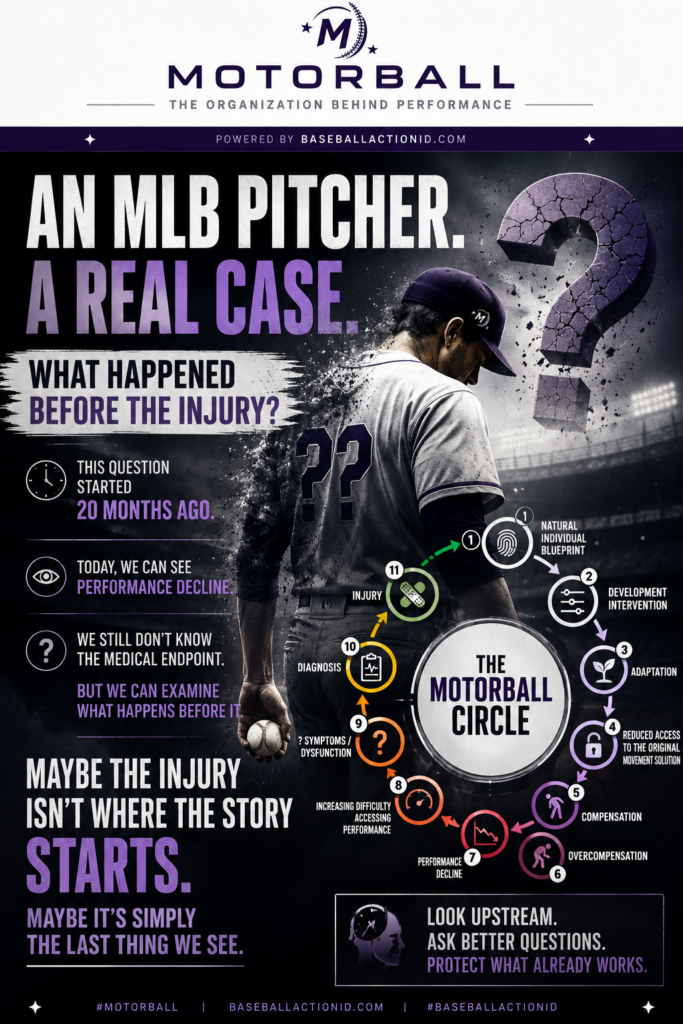
AN MLB PITCHER. A REAL CASE.
WHAT HAPPENED BEFORE THE INJURY?
Last week, I argued that the injury is not the starting point.
The starting point is the athlete.
His individual movement organization.
What was working before intervention began.
And what may have changed along the way.
The question was simple:
Did we lose access to something that was already working?
This week, I want to put that question against a real-world example.
Not by naming the pitcher.
Not by naming his organization.
Not by diagnosing him.
And not by predicting what happens next.
But by looking at a high-end MLB pitcher whose performance profile is changing.
And that makes the case particularly interesting.
Because the story is still unfolding.
THIS QUESTION STARTED 20 MONTHS AGO
Approximately 20 months ago, I was in a professional conversation with a pitching coordinator from his organization about this pitcher.
My concern was not an injury.
It was movement organization.
By that point, the athlete had already developed through a high-level college environment and entered professional baseball.
My concern was that I was seeing his movement organization increasingly move outside what I considered his natural individual blueprint.
And I said something very specific:
I don’t think the question is whether this eventually becomes a problem.
The question is when it becomes visible.
That was not a medical prediction.
It was a MotorBall observation.
The concern was about what happens when an elite athlete increasingly has to access performance through a movement solution that is different from the one that naturally made him successful.
THE MOTORBALL CIRCLE
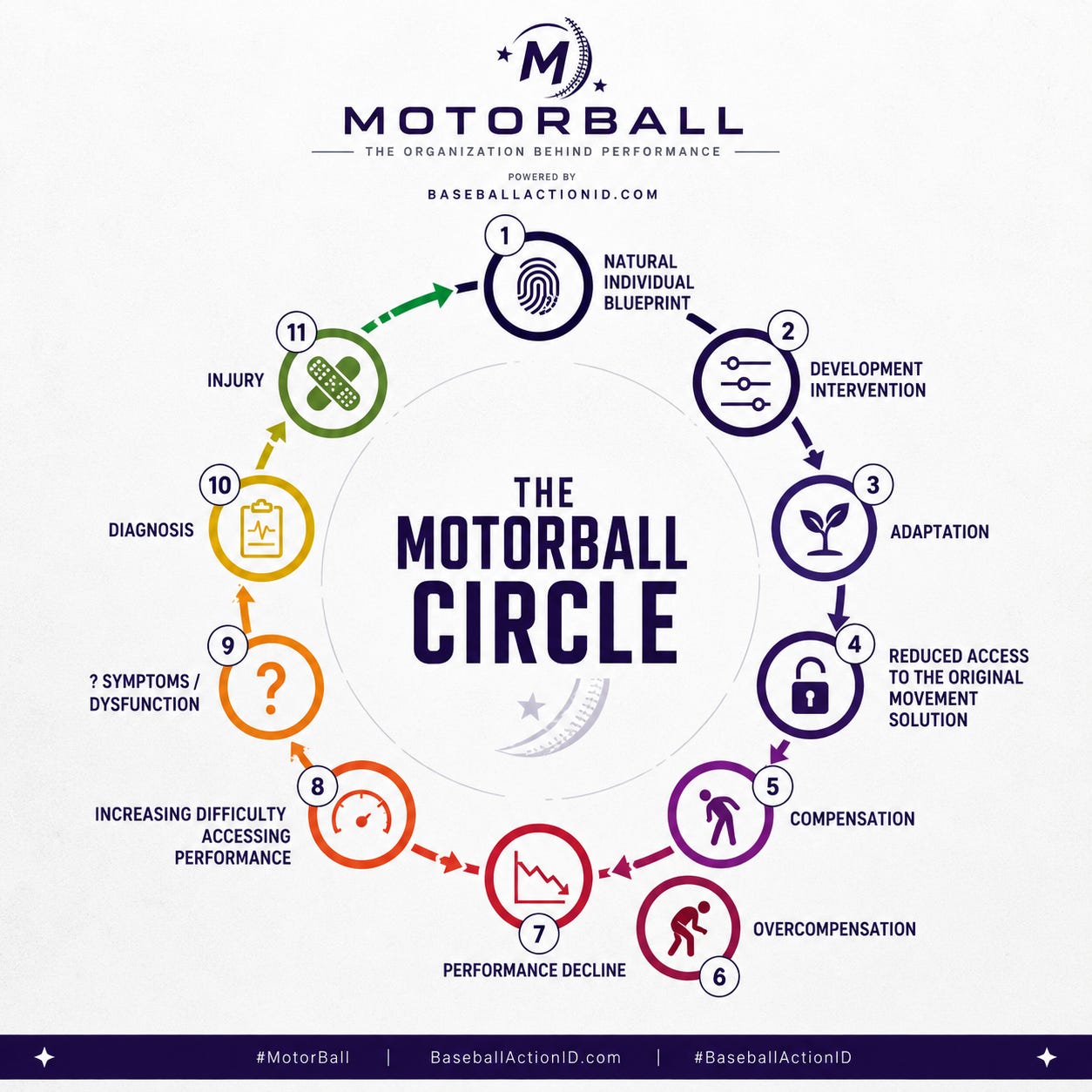
The question mark matters.
Because we don’t know what comes next.
And we shouldn’t pretend we do.
NOW LOOK AT THE PERFORMANCE
The high-end MLB pitcher we are discussing is still pitching.
But that is no longer the important observation.
His outings are going in the wrong direction.
The overall performance profile has changed.
The velocity has changed.
The consistency has changed.
And the pitcher we are seeing today is not producing at the same level as the high-end pitcher we saw before.
None of this proves injury.
None of it establishes dysfunction.
And none of it gives us a diagnosis.
But it does give us something important:
Observable performance decline.
And that changes the question.
THE QUESTION ISN’T “IS HE STILL PITCHING?”
Of course he is.
The better question is:
Is he still accessing the same level of performance through the same movement solution?
Because those are two very different things.
An athlete can continue competing while progressively losing access to the solution that originally made him exceptional.
The athlete adapts.
He finds another way.
Performance continues.
Until eventually the new solution may itself become increasingly difficult to sustain.
That is the part MotorBall wants to understand.
LOOK UPSTREAM
The traditional question is:
What happened?
Velocity changed.
Performance declined.
Something is different.
But MotorBall asks another question:
What changed before the output changed?
Was access to the original movement solution reduced?
Did adaptation become necessary?
Did compensation become increasingly important?
And eventually:
Did the athlete begin having increasing difficulty accessing a level of performance that was previously available to him?
That is a much earlier question.
And potentially a much more valuable one.
THE QUESTION MARK IS THE POINT
We don’t know what sits after:
Increasing difficulty accessing performance
↓
?
Maybe there is no medical problem.
Maybe there is.
Maybe something else is happening entirely.
We don’t know.
And that is precisely why this case is worth watching.
Because we don’t have to wait for a diagnosis to ask whether something has already changed.
WHAT IF PERFORMANCE DECLINE ISN’T THE START?
This is where the conversation becomes uncomfortable.
What if the decline we can see today is not where the story started?
What if it is simply the first visible evidence that the athlete has been having increasing difficulty accessing the movement solution that once made him exceptional?
Twenty months ago, the question was about movement organization.
Today, we can see performance decline.
We still don’t know the final chapter.
But perhaps we don’t need the final chapter to start asking better questions.
Because once an injury appears, everyone wants to know:
What happened?
MotorBall wants to ask earlier:
WHAT CHANGED BEFORE THE INJURY EVER BECAME VISIBLE?
And perhaps the most important question is:
HOW EARLY CAN WE RECOGNIZE THAT AN ATHLETE IS LOSING ACCESS TO THE PERFORMANCE WE ALREADY KNEW HE COULD PRODUCE?
Because maybe the injury isn’t where the story starts.
Maybe it’s simply the last thing we see.
#MotorBall