BASEBALL’S PITCHING INJURY EPIDEMIC
The Definition of Insanity: Why Do We Keep Doing the Same Thing?
Another season. Another wave of pitching arm injuries.
Tommy John surgeries. Serious elbow injuries. Thoracic Outlet Syndrome (TOS). Major shoulder surgeries. Pitchers losing months, sometimes entire seasons. Careers being interrupted before they have reached their potential.
And as we move through 2026, the same alarming pattern continues to dominate the conversation around professional pitching.
Every injury brings another investigation. Another explanation. Another proposed adjustment. Another attempt to identify what went wrong.
Velocity. Workload. Mechanics. Fatigue. Recovery. Pitch design. Biomechanics.
All relevant. All worth investigating.
But here is the question baseball needs to confront:
How many more pitchers have to get hurt before we seriously reconsider the way we develop them?
Baseball has more technology than ever. More data. More sophisticated bio-mechanical analysis. More detailed tracking. More ways to monitor and optimize performance.
Yet the challenge of keeping pitchers healthy remains one of the game’s most persistent problems.
At what point do we stop assuming that adding more of the same will eventually solve it?
THE NUMBERS SHOULD MAKE EVERYONE STOP AND THINK
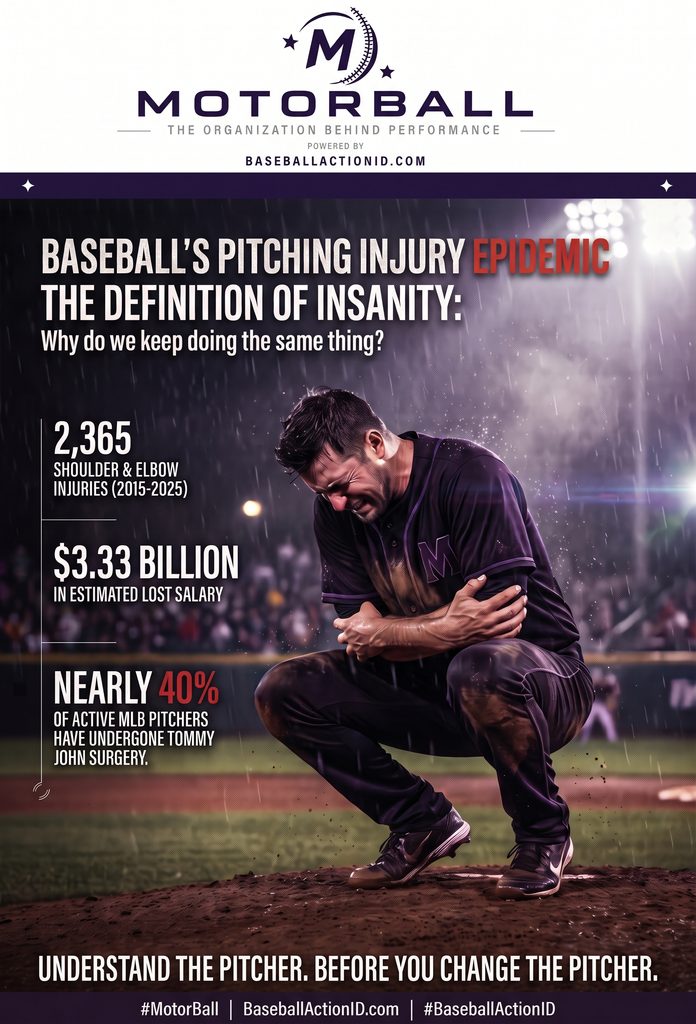
A 2026 study examining MLB pitchers from 2015 through 2025 identified 2,365 shoulder- and elbow-related injured-list stints involving 1,122 pitchers.
The estimated salary lost associated with those injuries exceeded $3.33 billion.
Elbow injuries accounted for approximately $2.28 billion of that total, with UCL injuries alone accounting for an estimated $1.29 billion.
The study also identified a significant upward trend in shoulder and elbow injury incidence over the period examined. Elbow-injury incidence increased approximately 2.9 times faster than shoulder-injury incidence.
And consider this: analysis of pitchers used during the 2025 MLB season indicated that nearly 40% had previously undergone Tommy John surgery.
Read that again.
Nearly 40%.
We are talking about professional pitchers at the highest level of the sport.
These numbers do not prove that every injury has the same cause. They do not establish that every development method has failed. But they reveal the enormous scale of a problem that baseball has yet to bring under control.
And as serious as the Major League numbers are, we haven’t even begun to talk about the Minor Leagues, where the injury picture is even more alarming.
This is not a handful of unlucky pitchers.
This is not something baseball can simply explain away as bad luck.
This is a problem that demands a fundamental rethink.
MORE DATA. MORE TECHNOLOGY. MORE OPTIMIZATION. STILL NO RELIABLE ANSWER.
Let’s be clear. I am not arguing against technology, biomechanics, pitch design, or performance science.
These disciplines have brought enormous value to baseball. We should continue improving them.
But there is a difference between measuring performance and understanding the individual who produces it.
We can measure velocity, spin, release characteristics, and movement. We can analyze positions, timing, and biomechanical variables. We can identify changes and quantify results with extraordinary precision.
But does knowing exactly what a pitcher is doing automatically tell us whether we understand how that individual naturally organizes movement?
Does a measured position explain the organization that produced it?
Does an improvement in a performance metric tell us everything we need to know about the demands being placed on the athlete?
A measurement can be accurate while our interpretation remains incomplete.
A pitcher’s movement may reflect natural organization, years of coaching, imitation, adaptation, physical limitations, previous injury, or a combination of factors.
If we don’t understand those influences, we risk treating the visible movement as the whole story.
And if we change that movement without understanding the individual behind it, we may be optimizing a result without fully considering the person who has to produce it.
This is where baseball needs to look harder.
Not at whether technology is useful.
Not at whether pitch design matters.
But at whether we understand the pitcher well enough before deciding how that pitcher should move.
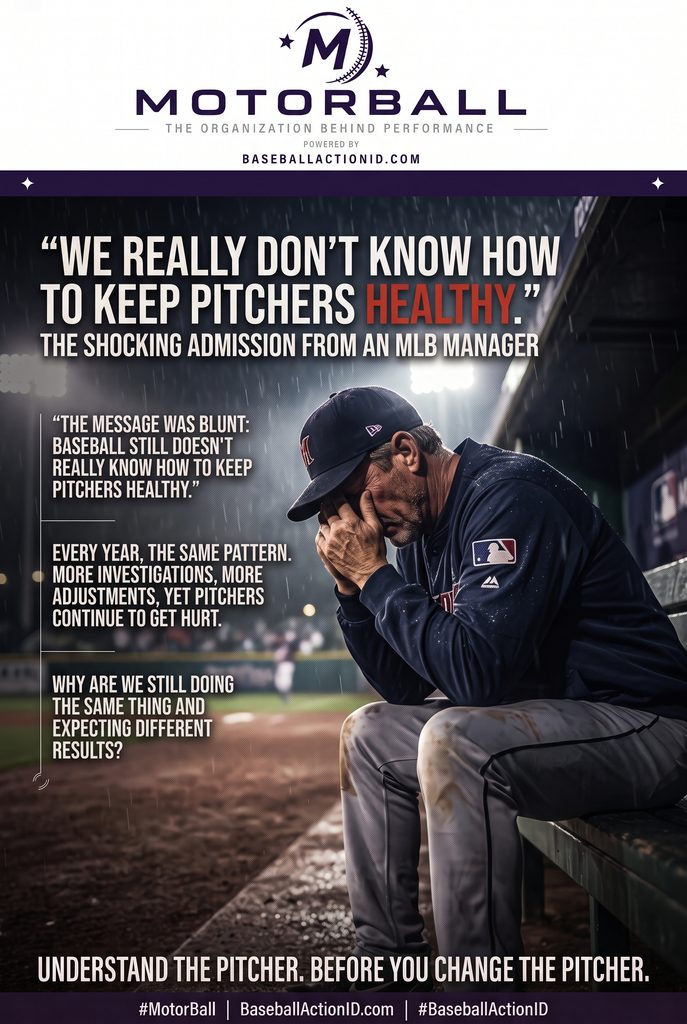
“WE REALLY DON’T KNOW HOW TO KEEP PITCHERS HEALTHY.”
A few weeks ago, during a televised broadcast, I heard an MLB manager express a striking admission about the challenge of keeping pitchers healthy.
The message was blunt: baseball still doesn’t really know how to keep pitchers healthy.
I am deliberately not naming the manager. This is not about blaming one individual or criticizing the people working tirelessly inside the game.
It is about the significance of that admission.
Think about the expertise, money, research, technology, and resources invested in pitching performance.
Then think about the continuing uncertainty surrounding one of the most important responsibilities in the game: keeping pitchers healthy and available.
If people working at the highest level of baseball are still expressing that frustration, perhaps we need to be more willing to question the assumptions behind our current approach.
We cannot reasonably expect every injury to be preventable. Baseball is a complex sport, and injuries have multiple contributing factors.
But that does not justify accepting the current situation as inevitable.
If we still struggle to keep pitchers healthy, we have to be willing to question whether we are looking at the problem from the right perspective.
THE DEFINITION OF INSANITY
There is a famous expression often attributed to Albert Einstein:
“The definition of insanity is doing the same thing over and over again and expecting different results.”
The attribution is disputed, but the message is impossible to ignore.
Look at the cycle baseball keeps repeating.
Pitchers get hurt.
We investigate the injury.
We analyze the mechanics, workload, physical demands, and other possible contributing factors.
We introduce adjustments, new monitoring methods, and new performance strategies.
Then another season arrives.
And pitchers get hurt again.
Of course, baseball evolves. Organizations are constantly learning, and many interventions genuinely help individual athletes. But the broader problem remains substantial.
At what point do we stop asking only how to improve our existing approach and start asking what our approach might be missing?
If the injury burden persists despite all the progress in measurement and performance optimization, then perhaps the answer is not simply to measure more, monitor more, or optimize harder.
Perhaps we need to examine the individual pitcher differently.
Because if we keep focusing on the visible output while overlooking the organization of the person producing it, we may continue to miss an important part of the picture.
A QUESTION FROM AN MLB DIRECTOR OF PLAYER DEVELOPMENT
There is a question I was asked last off-season that has stayed with me.
I had spent considerable time with an MLB pitching coach and his Director of Player Development, explaining MotorBall and the concept of the Motor Signature.
The conversation was about understanding the individual pitcher first.
Natural organization.
Movement.
Performance.
Long-term development.
After the presentation, the Director of Player Development asked me:
“If we followed this MotorBall approach, would our pitchers still throw hard?”
I remember the question because of what it revealed.
Not about MotorBall.
About the way we have come to think about player development.
Why would understanding how a pitcher naturally organizes movement imply that we would somehow take velocity away from him?
Why has the conversation become:
Natural organization vs. velocity?
Individualization vs. performance?
Understanding the athlete vs. maximizing stuff?
There is no such choice.
And perhaps that is exactly the problem.
We have become so focused on developing the desired performance outcome that understanding the individual can appear to be a secondary consideration.
But why should it be?
Why should understanding a pitcher’s natural blueprint be seen as a potential obstacle to throwing hard rather than a foundation for making better development decisions?
And when the sport is struggling with a persistent pitching-injury epidemic, why would we not want to understand the individual before attempting to change the individual’s movement?
That is the question.
Not whether MotorBall will take velocity away.
But why understanding the pitcher should ever be considered a threat to performance in the first place.
THE MISSING PIECE: THE INDIVIDUAL PITCHER
Velocity is not the enemy.
Pitch design is not the enemy.
Biomechanics is not the enemy.
The problem begins when the desired outcome becomes the organizing principle—and the individual who has to produce that outcome becomes secondary.
A pitch can be effective. A mechanical adjustment can produce an immediate improvement. A new approach can increase velocity.
But achieving a desired outcome does not automatically tell us whether the approach is appropriate for that particular pitcher.
Different individuals do not necessarily organize movement in the same way. The same instruction or imposed movement strategy can create different demands on different athletes.
That matters when we are deciding how to develop a delivery, change a movement pattern, or build a pitch.
We should not begin only with the question:
What do we want this pitcher to produce?
We should also ask:
How does this pitcher naturally organize movement, and are we building the development strategy around that individual?
This is where MotorBall and the concept of the Motor Signature bring a different perspective.
The Motor Signature concerns the individual’s natural organization of movement. Understanding that organization gives us another layer of information to consider before deciding how to coach, adjust, and develop the athlete.
It does not replace medical expertise, biomechanical analysis, workload management, or pitch design.
It adds a question that should not be overlooked.
Are we developing the pitcher through an understanding of the individual—or asking the individual to conform to a model that may not fully respect that person’s natural organization?
INJURY PREVENTION MUST START BEFORE THE INJURY
For me, this is where the conversation needs to change.
Injury prevention cannot be limited to responding to warning signs, adjusting workloads, monitoring symptoms, or intervening after something goes wrong.
Those measures matter. But we should also examine how the athlete is being developed in the first place.
Respecting an individual’s natural blueprint should be a central consideration in injury prevention—not an optional extra.
I firmly believe that understanding a pitcher’s Motor Signature and respecting that individual’s natural organization can significantly improve our approach to injury prevention.
Why?
Because development decisions should account for the individual who has to execute them.
If we understand how a pitcher naturally organizes movement, we have a stronger basis for evaluating whether a proposed change fits that individual, what it asks the athlete to do, and whether another approach deserves consideration.
That does not mean every movement that looks natural is automatically safe. It does not mean every injury can be prevented by respecting a Motor Signature. And it does not mean MotorBall can replace medical assessment or the other disciplines involved in keeping pitchers healthy.
It means that the individual athlete should be part of the equation from the beginning—not considered only after a problem develops.
We need to stop assuming that a movement solution that works for one pitcher is automatically the right solution for another.
We need to stop treating the desired outcome as sufficient evidence that we have found the right development strategy.
And we need to recognize that understanding the individual is not in opposition to maximizing performance.
It is part of making better decisions about how performance is developed and sustained.
THE PITCHER SHOULD NOT HAVE TO FIT THE PITCH
Pitch design is an important part of modern baseball. Organizations should continue looking for ways to improve pitch characteristics and effectiveness.
But the process needs to account for the individual producing the pitch.
The starting point should not be limited to the pitch we want to create. It should include the pitcher who has to create it.
The pitch should be developed through the pitcher. Not the pitcher through the pitch.
That is not a rejection of pitch design. It is a challenge to make pitch design more individual.
The same principle applies to mechanics and movement coaching.
Rather than assuming that the same desired position or movement strategy is appropriate for everyone, we should understand the athlete’s natural organization and use that information when making development decisions.
The sequence matters:
Motor Signature → whole-body organization → natural movement organization → pitch design → pitch outcome.
The objective is not to abandon performance targets.
It is to pursue those targets with a better understanding of the individual.
Because the pitcher is not a machine designed to produce a number.
The number is an expression of the pitcher.
HOW MUCH MORE EVIDENCE DO WE NEED?
The pitching-injury problem is not going away simply because baseball continues to advance technologically.
The 2026 season has brought the issue back into focus. The published evidence already documents a substantial, growing long-term burden of shoulder and elbow injuries among MLB pitchers. The exact final figures for each injury category will depend on the completed season and the way injuries are counted.
But we do not need to wait for another set of annual totals before asking whether the current approach is sufficient.
We cannot predict the exact number of Tommy John surgeries, TOS diagnoses, or major shoulder procedures that will occur next season.
But unless we are prepared to examine the assumptions behind pitcher development, why should we expect the problem to disappear?
Baseball does not need less science.
It does not need less data.
It does not need to abandon the expertise that has helped the game evolve.
It needs to stop assuming that more information automatically means a complete understanding of the athlete.
We need to keep improving how we measure performance—and improve how we understand the individual producing it.
We need to ask different questions before making development decisions.
We need to recognize that natural organization and performance are not opposing objectives.
And we need to take the relationship between the individual pitcher, movement development, and injury prevention far more seriously.
This is the perspective MotorBall brings to the conversation:
Information → Organization → Movement.
Understand the individual. Understand how that individual organizes movement. Then make informed decisions about development, mechanics, and pitch design.
I believe that respecting the Motor Signature and the natural blueprint of the individual can make a meaningful difference in how we approach injury prevention.
Not because it promises to eliminate every injury.
Because we cannot afford to keep treating the individual as secondary to the outcome we want to achieve.
The question is no longer whether baseball has enough tools to analyze pitchers.
The question is whether we are willing to reconsider how we use those tools—and whether we are willing to understand the pitcher before trying to change the pitcher.
If we want a different outcome, we must be willing to question the process that keeps producing the same problem.
How many more pitchers have to get hurt before we make that change?