PART 1 OF 2: THE HIDDEN DIVIDE IN PLAYER DEVELOPMENT
Why Half Your Roster is Asking the Wrong Question
(This is Part 1: The Concept. Next week in Part 2, we break down the practical coaching cues to solve it).
Last week, we looked at Pronators and Supinators.
We asked a fundamental question:
Are we measuring what the pitcher naturally organizes — or are we simply measuring what the pitcher has learned to produce?
When we only look at the release, we are looking at the very end of the chain. Today, we are going to the absolute beginning. Because before an athlete ever moves, before they ever sequence their mechanics, they have to organize information.
Put two players in the exact same situation.
Give them the exact same information.
Ask them to make the exact same adjustment.
One player might immediately execute it perfectly.
The other might freeze, overthink, and completely lose his natural rhythm.
Why does this happen?
The baseball industry has a standard list of answers for this.
We say the second player isn’t coach-able.
We say he lacks body awareness.
We say he’s too mechanical.
But what if the problem has nothing to do with intelligence, talent, or coach-ability?
What if the problem is that we assume both players organize information into action the exact same way?
THE WAY WE ORGANIZE TOWARD ACTION
Within the #MotorBall framework, before we ever look at mechanics, we have to look at how an athlete naturally organizes themselves toward action.
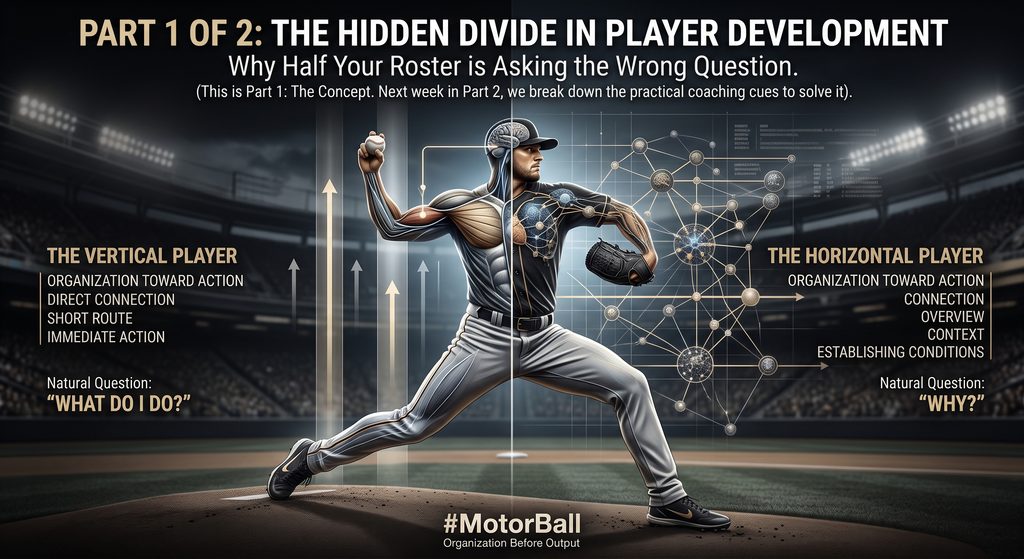
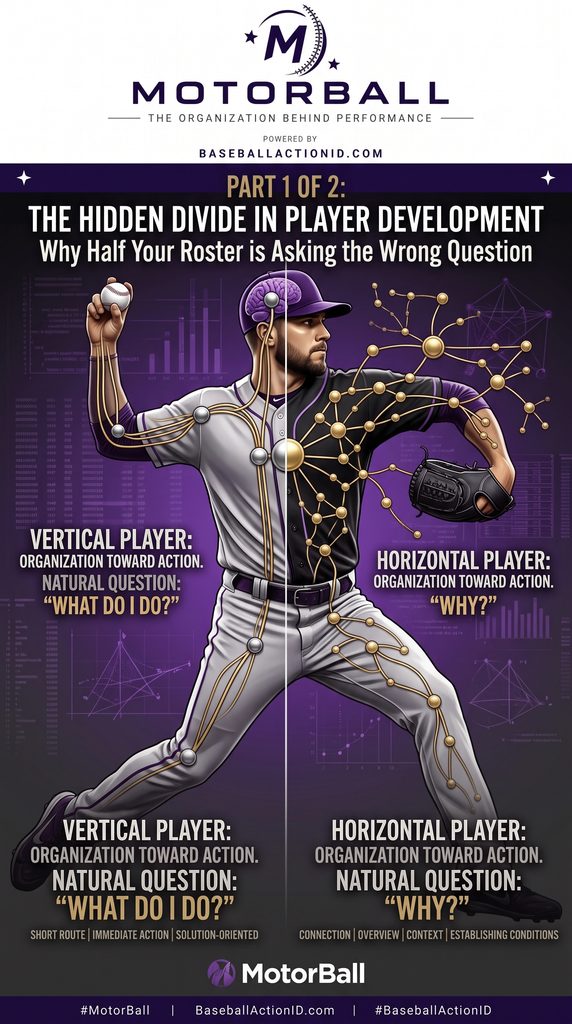
One of the most powerful distinctions you can make on a baseball field is recognizing whether a player is Vertical or Horizontal.
These terms describe how an individual’s nervous system naturally organizes information and prepares for movement.
THE VERTICAL PLAYER A Vertical-dominant player operates on a direct line. They need to move to facilitate decision making. Their natural tendency is toward:
- The shortest route.
- Immediate action.
- Solution-oriented thinking.
When a Vertical player is given a task, their brain immediately wants to bypass the theory and get to the execution.
Their natural question is:
“Got it. What do you want me to do?”
THE HORIZONTAL PLAYER: A Horizontal-dominant player operates rationally. They need to decide and position themselves before they start moving. Their natural tendency is toward:
- Connection.
- Overview.
- Context.
- Establishing the conditions first.
When a Horizontal player is given a task, they cannot simply execute a blind command. Their brain needs to understand how this new piece of information fits into the rest of their movement chain.
Their natural question is:
“Why? What needs to be in place before I act?”
THE COACHING MISMATCH
This is where player development often breaks down.
We have access to more data and better bio-mechanical insights than ever before. But we often deliver that information using a universal coaching language.
Think about a standard coaching cue on the mound or in the cage.
If you give a purely Vertical instruction (action-oriented) to a Horizontal player (context-oriented), the player won’t process it as clarity. They will process it as friction.
What happens next is entirely predictable:
The player tries to force the physical movement without understanding the underlying conditions. Their natural organization gets disrupted. Tension builds. Rhythm disappears.
And suddenly, the player looks worse than before you started coaching them.
THE REAL QUESTION
We spend enormous amounts of time deciding what we should coach an athlete to do.
Perhaps we should spend more time asking how that athlete naturally organizes information before turning it into action.
Vertical or Horizontal?
Neither is better. Neither is worse.
They are simply different biological pathways to getting to the exact same destination.
If you don’t know which pathway your player uses, you are essentially guessing every time you give a cue.
Next week, in Part 2:
We are going to look at the practical application.
We will break down specific examples of hitting and pitching cues, how they cause friction for certain players, and how you can become a “bilingual” coach by slightly adjusting your language to unlock the players you previously couldn’t reach.