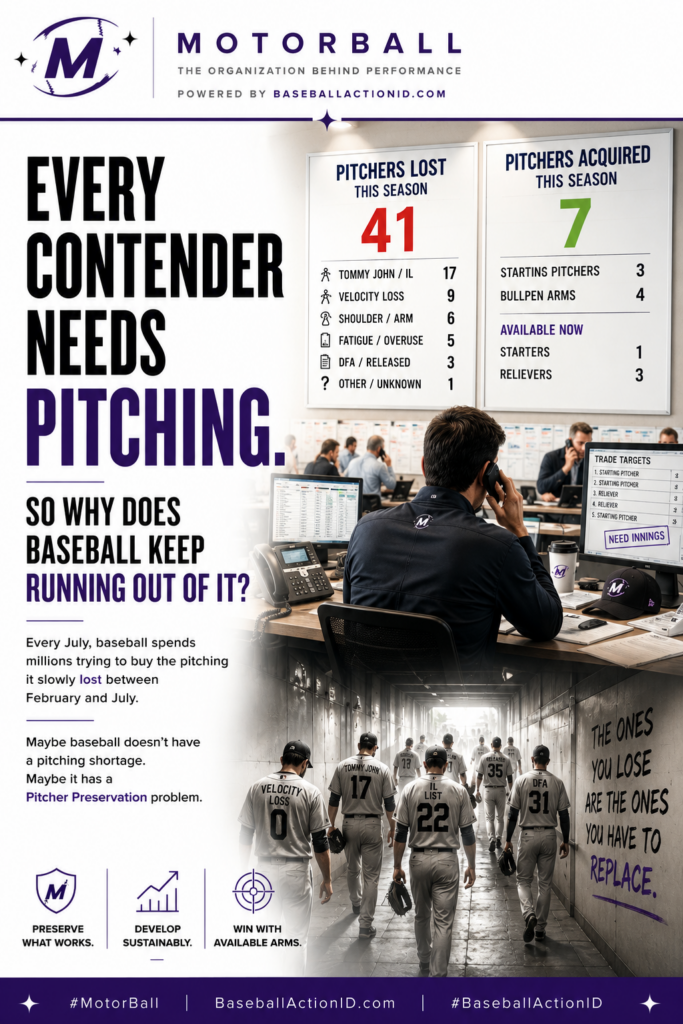
Every Contender Needs Pitching.
So why does baseball keep running out of it?
Just a few days ago, I wrote that the most valuable prospect isn’t always the highest-ranked prospect.
The central idea was simple.
Talent doesn’t have the same value inside every organization.
Development matters.
Compatibility matters.
And perhaps the greatest competitive advantage isn’t simply finding better players…
…It’s understanding which players your organization is actually built to develop.
Now, as the Trade Deadline approaches, baseball has shifted into a different conversation.
Every contender is searching for pitching.
Every front office is asking the same question.
Who’s available?
Starting pitchers.
Bullpen arms.
Reliable innings.
Veteran experience.
Rental relievers.
Every July…
It’s the same story.
But what if baseball is still asking the wrong question?
What if the real question isn’t…
“Where can we find more pitching?”
What if it’s…
“Why does baseball keep running out of it?”
Every July Looks Exactly the Same
Contenders need pitching.
Buyers call sellers.
Prospects change organizations.
Bullpens get reinforced.
Starting rotations are patched together.
Millions of dollars are committed.
Top prospects are traded.
Every year, baseball behaves as if quality pitching has suddenly become scarce.
Yet this isn’t a surprise.
It happens…
Every…
Single…
Season.
Which raises a question that almost nobody asks.
If every contender is desperately searching for pitching every July…
Why does baseball keep running out of it?
Baseball Calls It a Pitching Shortage
That’s the common explanation.
“There just isn’t enough pitching.”
Injuries.
Velocity.
Bad luck.
Workload.
The calendar.
Those explanations aren’t wrong.
But they all describe the symptom.
Very few people stop to ask why the same symptom keeps returning every season.
Perhaps baseball doesn’t actually have a pitching shortage.
Perhaps it has something much deeper.
Every July Baseball Tries To Buy Back What It Slowly Lost
Think about that for a moment.
Every July, organizations spend millions trying to acquire the pitching they gradually lost between February and July.
Not because those pitchers never existed.
Because somewhere along the way…
They became unavailable.
Sometimes through injury.
Sometimes through declining performance.
Sometimes through inconsistency.
Sometimes because the pitcher who arrived in spring training simply isn’t the same pitcher by midsummer.
That isn’t just a roster problem.
It’s a developmental question.
Organizations Don’t Lose Pitchers Overnight
This is where I believe the conversation changes.
Organizations rarely lose a pitcher in one dramatic moment.
More often…
They slowly lose access to the qualities that made that pitcher valuable in the first place.
Velocity becomes harder to reproduce.
Command becomes less consistent.
Recovery becomes more difficult.
Confidence slowly disappears.
Mechanical changes accumulate.
Pitch design keeps evolving.
New movement goals replace old movement solutions.
None of those decisions are necessarily wrong.
Most are made with the best intentions.
But over time…
The athlete gradually moves further away from the movement organization that originally allowed him to perform at his highest level.
Eventually, organizations find themselves searching for the very thing they once believed they already possessed.
Maybe This Isn’t About Finding More Pitchers
It’s about preserving the ones you already have.
That’s a very different conversation.
Baseball invests enormous resources into identifying talent.
It invests enormous resources into acquiring talent.
It invests enormous resources into improving talent.
But perhaps not enough attention is given to preserving the movement qualities that made that talent exceptional in the first place.
MotorBall would call this Pitcher Preservation.
Not simply injury prevention.
Not workload management.
Not arm care.
Something much broader.
Preserving the natural movement organization that allows performance to remain accessible over an entire season.
Development Isn’t Just About Getting Better
It’s also about not becoming worse.
That sounds obvious.
Yet baseball often defines development as adding.
Add velocity.
Add a pitch.
Add extension.
Add sweep.
Add efficiency.
Add force.
Add mechanical changes.
Sometimes those additions create extraordinary results.
Sometimes they do something else.
They slowly disconnect an athlete from the movement solutions his nervous system naturally trusted long before professional baseball ever entered the picture.
The pitcher may still throw.
He may still compete.
He may still look athletic.
But the qualities that once made him unique become increasingly difficult to access.
That’s not always an injury story.
Sometimes it’s simply the quiet erosion of performance.
The Most Valuable Trade Might Be The One You Never Have To Make
Every contender hopes to strengthen its pitching staff in July.
That’s understandable.
Winning organizations should always look for opportunities.
But imagine a different question.
What if your biggest Trade Deadline acquisition…
Was the pitcher you never lost in the first place?
The starter who still trusts his movement.
The reliever whose natural organization has been strengthened instead of overwritten.
The athlete whose development has preserved rather than replaced what already worked.
That pitcher never appears on the trade market.
Because he never had to.
The Hidden Competitive Advantage
Perhaps baseball’s greatest competitive advantage isn’t finding more pitching.
Perhaps it’s becoming one of the few organizations that consistently preserve it.
Imagine entering every July needing one less starter.
One less reliever.
One less emergency acquisition.
Not because you spent more money.
Not because you drafted better.
Not because you got lucky.
But because your development system consistently protected access to the qualities that made your pitchers valuable in the first place.
That’s a very different definition of player development.
And perhaps…
A very different definition of roster construction.
Before You Ask Who’s Available…
Every Trade Deadline begins with the same question.
Who’s available?
MotorBall asks a different one.
Why do we keep needing more pitching every July?
Because maybe baseball doesn’t have a pitching shortage.
Maybe it has a Pitcher Preservation problem.
And perhaps the organizations that finally understand the difference…
Won’t just win more trades.
They’ll need fewer of them.