THE INJURY IS NOT THE STARTING POINT
Another year. Another wave of pitching injuries. So what are we actually looking at?
Last week, I ended with a question:
“How do we make sure we never lose the pitcher we already believed in?”
That question was about player development.
About what happens between the moment we identify a pitcher as valuable and the moment we look back and realize that something important has changed.
Because development is usually described in terms of what we add.
More velocity.
More strength.
More command.
More pitch shapes.
More efficiency.
More data.
More information.
But perhaps development also has another responsibility:
Protecting access to what already works.
The movement solutions that made the pitcher valuable.
The way he naturally organizes the task.
The way he stabilizes.
The way he creates force.
The way he finds space.
The way he solves the movement problem.
Those qualities were already there.
They were part of the reason we believed in the pitcher.
So perhaps the question from last week becomes even more important when we look at what is happening on the injury lists right now.
Because maybe we should ask:
What happens when we gradually lose access to the movement organization that made us believe in the pitcher in the first place?
ANOTHER YEAR. ANOTHER WAVE OF PITCHING INJURIES.
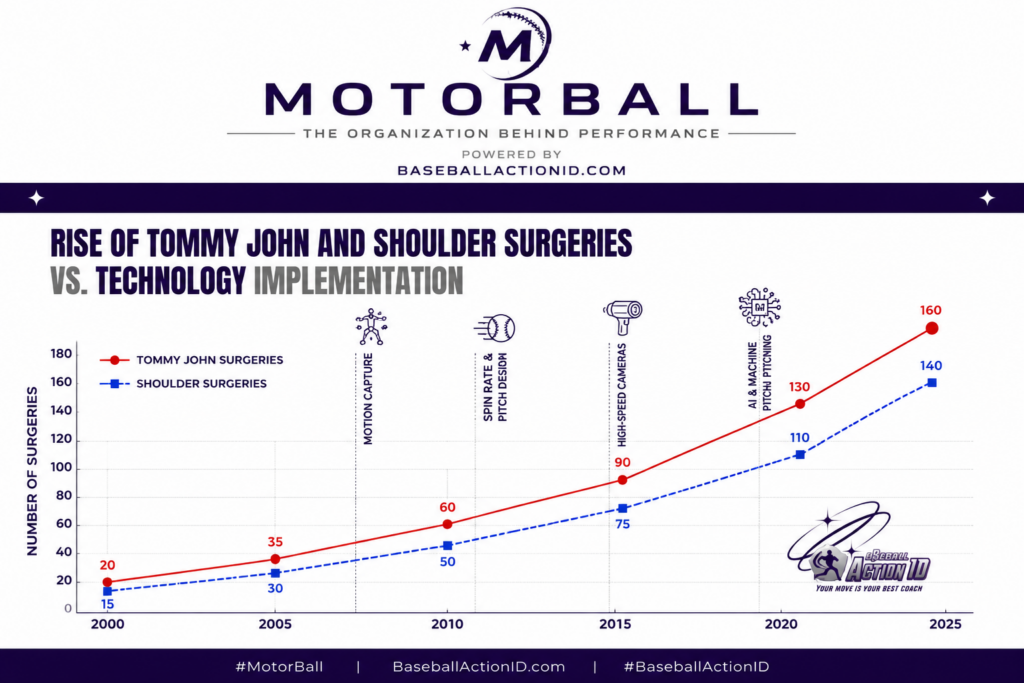
The 2026 season continues to produce new UCL cases requiring significant intervention, while TOS remains a recognized problem in professional pitching. Current injury databases also show a substantial population of pitchers unavailable because of previous Tommy John procedures and new elbow injuries.
And the list keeps growing.
Not occasionally.
Not every few weeks.
Daily. Weekly.
Another pitcher is added.
Then another.
Then another.
UCL.
Tommy John.
TOS.
Elbow.
Shoulder.
And the pitchers already lost to previous procedures remain part of the picture.
This is not a handful of isolated cases that can simply be discussed one at a time.
It is an accumulating population of unavailable pitchers.
And that accumulation is becoming increasingly difficult to ignore.
Because every individual injury can be explained as an individual medical event.
But when the same categories of serious pitching injuries continue appearing day after day, week after week, season after season, the conversation has to become bigger than the individual diagnosis.
At some point, the question is no longer:
“Why did this pitcher get hurt?”
The question becomes:
“Why does this keep happening to so many pitchers?”
And that is where the conversation gets uncomfortable.
Because the diagnosis tells us where the problem became visible.
It doesn’t necessarily tell us where the story started.
WE KNOW WHAT FAILED
Baseball is very good at describing the end of the process.
The UCL.
The elbow.
The shoulder.
The nerves.
The blood vessels.
The tissue.
The diagnosis.
The surgery.
And those things are real.
They matter.
But identifying what failed is not the same as understanding what changed before it failed.
That distinction matters.
Because an injury is an event.
Movement organization is a process.
And the process exists long before the event becomes visible.
THIS IS WHERE LAST WEEK’S QUESTION GETS INTERESTING
Last week I asked:
“How do we make sure we never lose the pitcher we already believed in?”
That question wasn’t about injury prevention.
It was about development.
About whether, in our attempt to improve the athlete, we can gradually move away from the qualities that originally made him valuable.
And that raises another question.
What if one way we lose that pitcher is by losing access to the movement organization that originally made him valuable?
The pitcher may still be there.
The velocity may still be there.
The pitch may still move.
The numbers may still look good.
The delivery may still look acceptable.
But the way the athlete accesses that performance may have changed.
And that is a very different problem.
Because baseball is exceptionally good at measuring performance.
I’m not convinced we’re equally good at measuring access to performance.
PERFORMANCE IS NOT THE SAME AS ACCESS
A pitcher can still throw 95.
He can still generate spin.
He can still create movement.
He can still compete.
He can still produce the numbers everyone wants to see.
But what if the organization underneath that output has changed?
What if something that once happened naturally now requires more effort?
What if a movement solution that was once readily available has become increasingly difficult to access?
What if another part of the body is now contributing differently to maintain the same result?
The output can remain stable.
The organization underneath it may not.
That distinction matters.
Because the radar gun sees the result.
The tracking system sees the result.
Video sees the movement.
The medical examination eventually sees the tissue.
But none of those things, by themselves, necessarily explain the organization that produced the movement.
THIS IS NOT AN ARGUMENT AGAINST DATA
Baseball should measure.
Absolutely.
Velocity matters.
Spin matters.
Movement matters.
Release characteristics matter.
Workload matters.
Biomechanics matter.
Medical information matters.
The problem is not that baseball has too much information.
The problem is assuming that more information about the output automatically means more understanding of the athlete.
Those are not the same thing.
We can become extraordinarily precise about what a pitcher produces while still not understanding how that particular pitcher naturally organizes himself to produce it.
And that is where MotorBall enters the conversation.
THE DELIVERY IS NOT THE SOURCE
A pitcher doesn’t simply decide:
“Today I’m going to use this arm slot.”
He doesn’t simply decide:
“Today I’m going to stabilize my trunk this way.”
He doesn’t simply decide:
“Today I’m going to create force through this exact sequence.”
The visible delivery is the result of a much deeper organization.
Information → Organization → Movement.
The athlete perceives the task.
The athlete organizes the movement.
The body produces the action.
The delivery is what we see.
The delivery is not the source.
That is why changing the visible delivery without understanding the organization behind it can become problematic.
You may be changing the consequence without understanding the system producing the consequence.
TWO PITCHERS CAN PRODUCE THE SAME RESULT
Two pitchers can throw:
95 mph.
They can have similar:
- Release characteristics;
- Spin;
- Movement;
- Pitch shape;
- Command;
- Velocity.
And yet they may not be organized in the same way at all.
One may be operating through a movement solution that is highly natural and readily accessible.
The other may be achieving the same external result through a solution that requires substantially more adaptation.
The radar gun sees:
95.
The pitcher may experience something completely different.
That’s why external similarity does not automatically mean internal similarity.
And that’s why a movement intervention that works beautifully for one pitcher cannot automatically be assumed to have the same effect on another.
THIS IS WHERE MOTOR PREFERENCES MATTER
Motor Signature/Preferences are not a list of perfect mechanics.
They are not a prescription for one universal delivery.
They are not an excuse to stop developing athletes.
They are about understanding how an individual naturally organizes movement.
Human movement is not standardized.
The athlete already has a movement organization before professional baseball begins changing things.
There is already a way of creating force.
Already a way of stabilizing.
Already a way of orienting.
Already a way of accessing space.
Already a way of organizing the throwing action.
That individual organization is part of the athlete.
And it is part of what made us believe in him.
THE PROBLEM STARTS WHEN WE CONFUSE CHANGE WITH IMPROVEMENT
Change is not bad.
Development requires change.
Athletes adapt.
Coaches intervene.
Strength changes.
Pitch design changes.
Training changes.
The question is not:
“Should we change the athlete?”
The better question is:
“What are we changing, and what are we asking the athlete to give up in order to get it?”
Because a change can improve an output while simultaneously making the underlying movement solution less accessible.
That is the uncomfortable part.
A pitcher can get better at something…
while becoming less himself.
And that was precisely the point of last week’s article.
COMPENSATION IS NOT THE INJURY
This distinction is critical.
MotorBall is not saying:
Compensation = injury.
That would be far too simplistic.
Compensation is part of human movement.
The body adapts.
It solves problems.
It finds alternatives.
That adaptability is one of the reasons humans are such extraordinary movers.
The MotorBall question is different:
What happens when compensation becomes the primary way an athlete has to solve a movement problem that previously required no such compensation?
That is where we should pay attention.
Because the athlete may still perform.
Sometimes exceptionally well.
The problem may not be visible in the result.
Yet the movement solution may have become less accessible.
TOS AND UCL ARE NOT THE SAME INJURY
This needs to be absolutely clear.
TOS and UCL injuries are different medical conditions.
Different anatomical structures.
Different pathology.
Different clinical presentations.
TOS can involve compression of nerves or blood vessels in the thoracic outlet.
UCL injury involves the ligament responsible for stabilizing the medial side of the elbow.
They are not the same injury.
So the MotorBall argument is not:
TOS and UCL injuries have the same medical cause.
They don’t.
The question is different:
Could different injury diagnoses still justify investigating how an individual athlete was organizing movement before the diagnosis?
That is a much more interesting question.
LOOK FURTHER UPSTREAM
The traditional investigation often begins with the event.
Pain.
Loss of performance.
Diagnosis.
Tissue.
Injury.
MotorBall asks us to move the starting point upstream.
Not because the medical diagnosis is wrong.
Because the diagnosis is describing the endpoint of a process.
What happened before that?
What changed?
What adapted?
What became less accessible?
What required compensation?
And perhaps most importantly:
What was the athlete doing naturally before we started changing things?
THE ATHLETE DOESN’T START AS A MECHANICAL BLANK PAGE
This is one of the biggest misunderstandings in player development.
A young pitcher doesn’t arrive without organization.
He already has one.
He has learned to perceive the environment.
He has learned to orient himself.
He has learned to stabilize.
He has learned to create movement.
He has learned to throw.
He has developed strategies that allow him to solve the task.
Those strategies are not random.
They are part of the individual’s motor organization.
And when that athlete enters a development system, the question should not simply be:
“What can we change?”
It should also be:
“What should we understand before we change it?”
That is a very different starting point.
THE OUTPUT CAN HIDE THE CHANGE
This is where the problem becomes particularly difficult.
If velocity drops dramatically, we notice.
If command disappears, we notice.
If pitch shape changes, we notice.
If performance collapses, we notice.
But what if none of those things happen?
What if the pitcher continues to perform?
What if the numbers still look good?
What if the delivery still looks acceptable?
What if the athlete has simply become less efficient at accessing the same movement solution?
That is much harder to detect.
And perhaps much more important.
Because the athlete can continue performing while the organization underneath the performance changes.
THE INJURY MAY BE THE LAST THING WE SEE
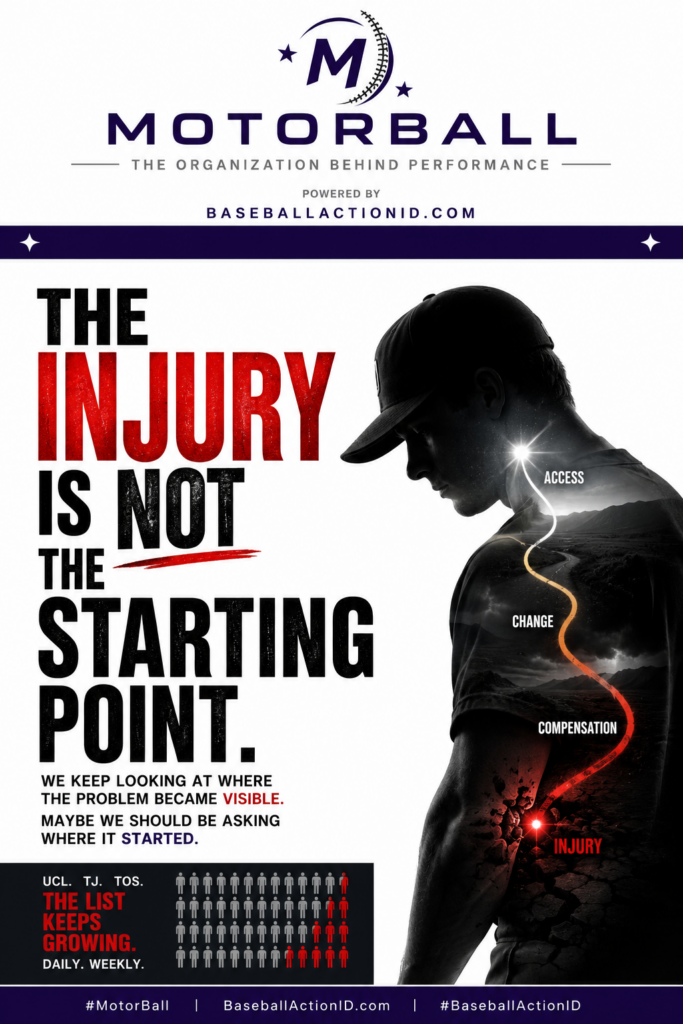
Consider this not as a medical injury pathway, but as a development question:
Natural movement organization
↓
Development intervention
↓
Adaptation
↓
Reduced access to the original solution
↓
Compensation
↓
Continued performance
↓
Increasing difficulty accessing performance
↓
Symptoms or dysfunction
↓
Diagnosis
↓
Injury
This is not a universal pathway.
It is not a diagnostic model.
It is not a claim that every UCL injury or TOS case follows this sequence.
It is a MotorBall framework for asking where the investigation should begin.
And baseball has historically tended to begin much later.
At the symptom.
At the diagnosis.
At the tissue.
MotorBall asks:
What happened before that?
THE CUMULATIVE SIGNAL
This is why the daily injury list matters.
Not because every injury has the same cause.
It doesn’t.
Not because every mechanical intervention is wrong.
It isn’t.
Not because every workload decision creates injury.
It doesn’t.
The point is the accumulation.
One injury can be an individual event.
Another can be another individual event.
Another can be another individual event.
But when the same broad categories of serious pitching injuries continue appearing:
Daily,
Weekly,
Season after season,
We should be willing to ask whether the problem deserves a broader investigation.
Not a single explanation.
Not a single culprit.
A broader investigation.
Because the repetition itself is information.
WE DON’T HAVE TO WAIT FOR THE INJURY
This may be the most important point.
If the goal is simply to identify injury, we already have medical systems for that.
If the goal is to treat injury, we already have extraordinary medical expertise.
But player development has another responsibility.
To understand the athlete while he is still performing.
Before the diagnosis.
Before the shutdown.
Before the surgery.
Before the problem becomes obvious.
That does not mean predicting exactly who will get hurt.
It does not mean claiming that MotorBall can diagnose injury.
It means paying attention to the organization of the athlete while he is still performing.
WHAT ARE WE ACTUALLY TRYING TO PRESERVE?
Maybe the question isn’t:
“How do we prevent every injury?”
That’s an impossible standard.
Maybe it is:
“How do we preserve the athlete’s access to the movement organization that makes his performance available?”
That’s different.
Because sustainability isn’t simply about surviving workload.
It isn’t simply about arm care.
It isn’t simply about strength.
It isn’t simply about mechanics.
It isn’t simply about pitch count.
It is about whether the athlete can continue solving the task through an organization that remains compatible with who he is.
THE WARNING SIGN MAY NOT BE THE INJURY
It might be something much quieter.
A movement that suddenly requires more thought.
A delivery that requires more conscious control.
A previously natural action that now needs repeated cueing.
A pitcher who can still perform but no longer has the same effortless access to that performance.
A movement solution that looks fine externally but has become increasingly difficult internally.
None of these automatically means injury.
But perhaps they deserve more attention than they currently receive.
Because by the time the tissue tells us something is wrong…
The athlete may have been telling us something for a long time.
THIS CONNECTS DIRECTLY TO PITCHER PRESERVATION
This is where last week’s question and the current injury problem meet.
If player development is partly about making sure we never lose the pitcher we already believed in, then preservation cannot simply mean preserving statistics.
It cannot mean preserving velocity alone.
It cannot mean preserving pitch shape alone.
It cannot mean preserving an arm slot.
It means preserving access to the athlete’s individual movement organization.
Because that organization is part of what made the athlete valuable.
And if we gradually remove access to it while improving individual outputs, we may eventually be developing a different pitcher.
A pitcher who can still perform.
A pitcher who can still produce.
But a pitcher who is solving the problem differently.
That distinction deserves far more attention.
BASEBALL DOESN’T HAVE AN INFORMATION PROBLEM
We have plenty of information.
Velocity.
Spin.
Movement.
Release.
Workload.
Biomechanics.
Strength.
Performance.
Symptoms.
Diagnosis.
Tissue.
The question is whether we are connecting that information at the right level.
We can tell you exactly what a pitcher produced.
But can we tell you how that particular athlete naturally organized himself to produce it?
And more importantly:
Can we tell when that organization starts changing?
Because that may be the information we are missing.
THE QUESTION BEFORE THE QUESTION
We keep asking:
“Why did this pitcher get hurt?”
Maybe we need to go one step earlier.
“What changed before the injury?”
And one step earlier again:
“What changed before the compensation?”
And one step earlier:
“What changed before the athlete lost access to his original movement solution?”
And perhaps the most important question:
“DID WE CHANGE SOMETHING THAT WAS ALREADY WORKING?”
Not intentionally.
Not maliciously.
Not because someone was incompetent.
But through hundreds of development decisions.
A mechanical adjustment.
A movement cue.
A pitch-design objective.
A strength intervention.
A new constraint.
A new model.
A new idea of what the delivery should look like.
Each decision may make sense in isolation.
The question is what happens when they accumulate.
THE DAILY INJURY LIST SHOULD MAKE US CURIOUS
Not afraid.
Not reactionary.
Curious.
Because the accumulation is telling us that something deserves deeper investigation.
Not one injury.
Not one pitcher.
Not one organization.
Not one coach.
Not one mechanical flaw.
The pattern.
The repetition.
The accumulation.
The fact that we continue to see serious pitching injuries appear day after day and week after week.
And perhaps the next level of player development is not finding another way to react to the injury.
Perhaps it is becoming much better at understanding the athlete before the injury becomes the story.
THE QUESTION FROM LAST WEEK STILL STANDS
“How do we make sure we never lose the pitcher we already believed in?”
Maybe now we can add another question:
“How do we make sure we don’t lose access to the movement organization that made us believe in him?”
Because perhaps losing the pitcher doesn’t begin when he goes on the Injured List.
Perhaps it begins earlier.
When natural movement solutions become less accessible.
When compensation becomes normal.
When the athlete continues to perform, but through an increasingly different organization.
When we optimize the output without understanding what is producing it.
And maybe that is one of the most important things player development should be trying to preserve.
THE QUESTION WE SHOULD BE ASKING
Not:
What failed?
We already know what failed.
Not:
What is the diagnosis?
Medical professionals can tell us.
Not:
What mechanic caused it?
That is often far too simplistic.
The player-development question is different.
WHAT CHANGED BEFORE THE INJURY?
And then:
WHAT CHANGED BEFORE THE COMPENSATION?
And perhaps the deepest question of all:
DID WE LOSE ACCESS TO SOMETHING THAT WAS ALREADY WORKING?
Because the Injured List tells us where the problem became visible.
It does not necessarily tell us where the story began.
And if we only start looking when the tissue fails…
We may already have missed the most important part.
THE INJURY IS NOT THE STARTING POINT.
The athlete is.