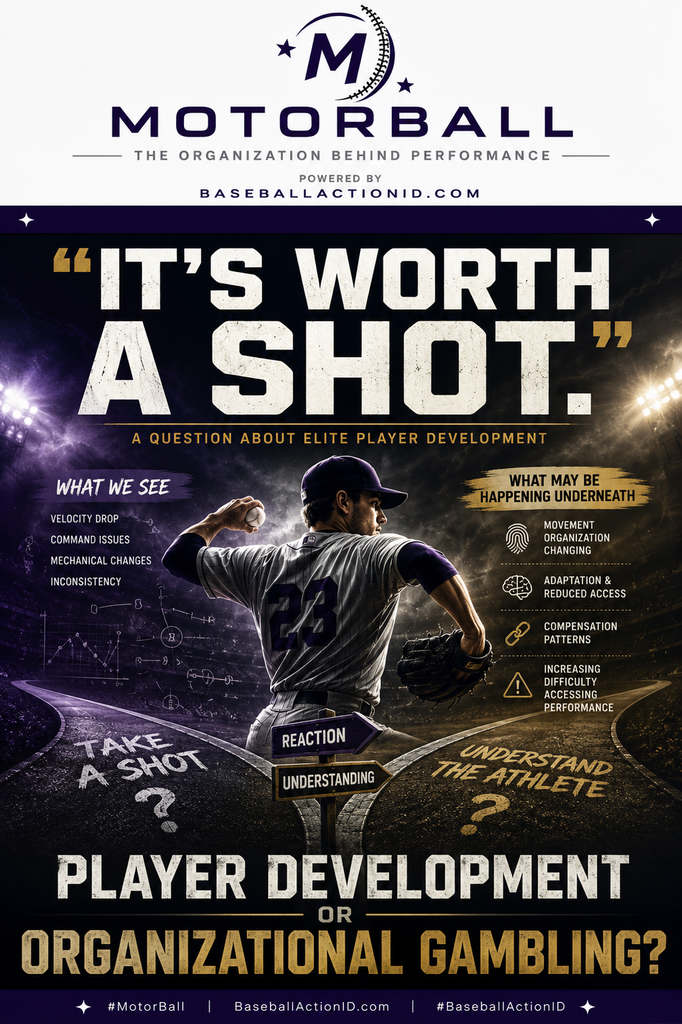
“IT’S WORTH A SHOT.”
Is That Player Development — Or Organizational Gambling?
Last week, we looked at Player X.
Not his name.
Not his organization.
The point was the process.
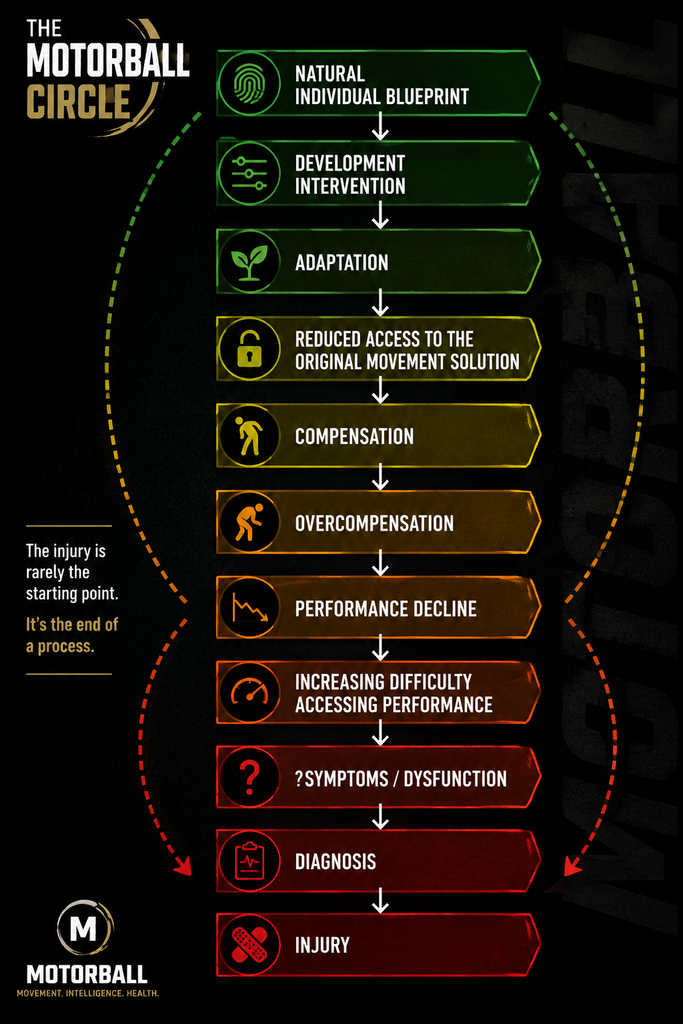
We looked at what can happen when an athlete’s natural individual blueprint is increasingly challenged or overridden — and how adaptation, reduced access, compensation and performance decline can develop over time.
The question was:
What is changing in the athlete before we ever have an injury to explain?
This week, four words caught my attention:
“It’s worth a shot.”
And I think those four words deserve more scrutiny.
IT’S WORTH A SHOT.
Maybe.
But when we’re talking about an elite MLB player — an athlete representing years of scouting, development, investment, performance resources and enormous organizational value — I think we should ask:
Worth the shot based on what?
Organizations have to make decisions under uncertainty.
They have to experiment.
Not every intervention will work.
That’s part of development.
But there is a difference between making an informed development decision and simply taking a shot to see what happens.
Is that player development — or organizational gambling?
THIS IS NOT AN ARGUMENT AGAINST EXPERIMENTATION
Experimentation is part of development.
Failure is part of development.
Adaptation is part of development.
The issue isn’t whether an organization should ever try something new.
The issue is what the decision is based on.
MotorBall starts somewhere different.
Before the intervention:
Who is this athlete?
What is his natural individual movement organization?
How does he access performance?
How does he adapt?
What happens when something changes?
And critically:
Does the intervention work with the athlete — or does the athlete simply learn to work around the intervention?
Those are not the same thing.
THE QUESTION STARTED 20 MONTHS AGO
There is one part of this story that should not be lost.
Approximately 20 months ago, I was in a professional conversation with a pitching coordinator from this player’s organization about Player X.
My concern was not an injury.
It was movement organization.
The athlete had already developed through a high-level college environment and entered professional baseball.
What concerned me was that I was seeing his movement organization increasingly move outside what I considered his natural individual blueprint.
And I made the concern very specific:
I don’t think the question is whether this eventually becomes a problem.
The question is when it becomes visible.
That conversation had nothing to do with “It’s worth a shot.”
And it had nothing to do with a “mechanical reset.”
Those are decisions and interpretations that came later.
The original MotorBall concern was much more fundamental:
What happens when an athlete increasingly has to access performance outside the movement organization that naturally made him successful?
That question started 20 months ago.
BECAUSE HUMAN BEINGS ARE NOT MACHINES
There is another part of this story that caught my attention.
While watching a discussion about Player X, an MLB analyst offered another possible answer:
“He needs a mechanical reset.”
And again, the language is interesting.
We’re talking about a human being.
Not a car.
Not a machine.
Not a system with a factory setting that can simply be restored.
A mechanical reset sounds simple.
But an athlete isn’t simply a collection of mechanical positions that can be returned to a previous configuration.
The athlete adapts.
The athlete learns.
The athlete organizes.
And what we see mechanically may be the visible consequence of how that athlete is currently organizing movement — not necessarily the source of the change.
So the MotorBall question isn’t:
“How do we reset the mechanics?”
It is:
“What changed in the athlete’s organization — and why?”
Because if we don’t understand that, we may be trying to reset the visible output without understanding the individual producing it.
THE SAME PLAYER CAN CHANGE
This becomes particularly important when an organization considers returning to a solution that has worked before.
The logic is understandable:
It worked before.
So:
Let’s try it again.
But here’s the question:
Is the athlete who responded to that solution before still organized in the same way today?
Because athletes aren’t static systems.
They develop.
They adapt.
They accumulate experience.
They accumulate workload.
They encounter new interventions.
Their available movement solutions can change.
And the relationship between an intervention and an athlete can change with it.
So:
Past success is evidence.
It is not automatically proof of present compatibility.
WHAT IF WE ARE LOOKING AT THE WRONG THING?
Performance changes.
We see the output.
Velocity changes.
Movement characteristics change.
Consistency changes.
The immediate instinct is often to find something to do.
Rest.
Reset.
Adjust.
Optimize.
None of these are automatically wrong.
But MotorBall asks a question before the intervention:
Do we understand why the athlete is producing the movement we are seeing?
Because if we don’t, we may end up trying to correct a movement that is actually the athlete’s adaptation to something deeper.
The delivery is not necessarily the source.
What we see may be the final visible expression of how the athlete has organized himself to solve the problem in front of him.
BACK TO PLAYER X
That’s why last week’s case matters.
The discussion wasn’t:
“This pitcher is injured.”
It was about something much earlier.
The possibility that an athlete can gradually experience:
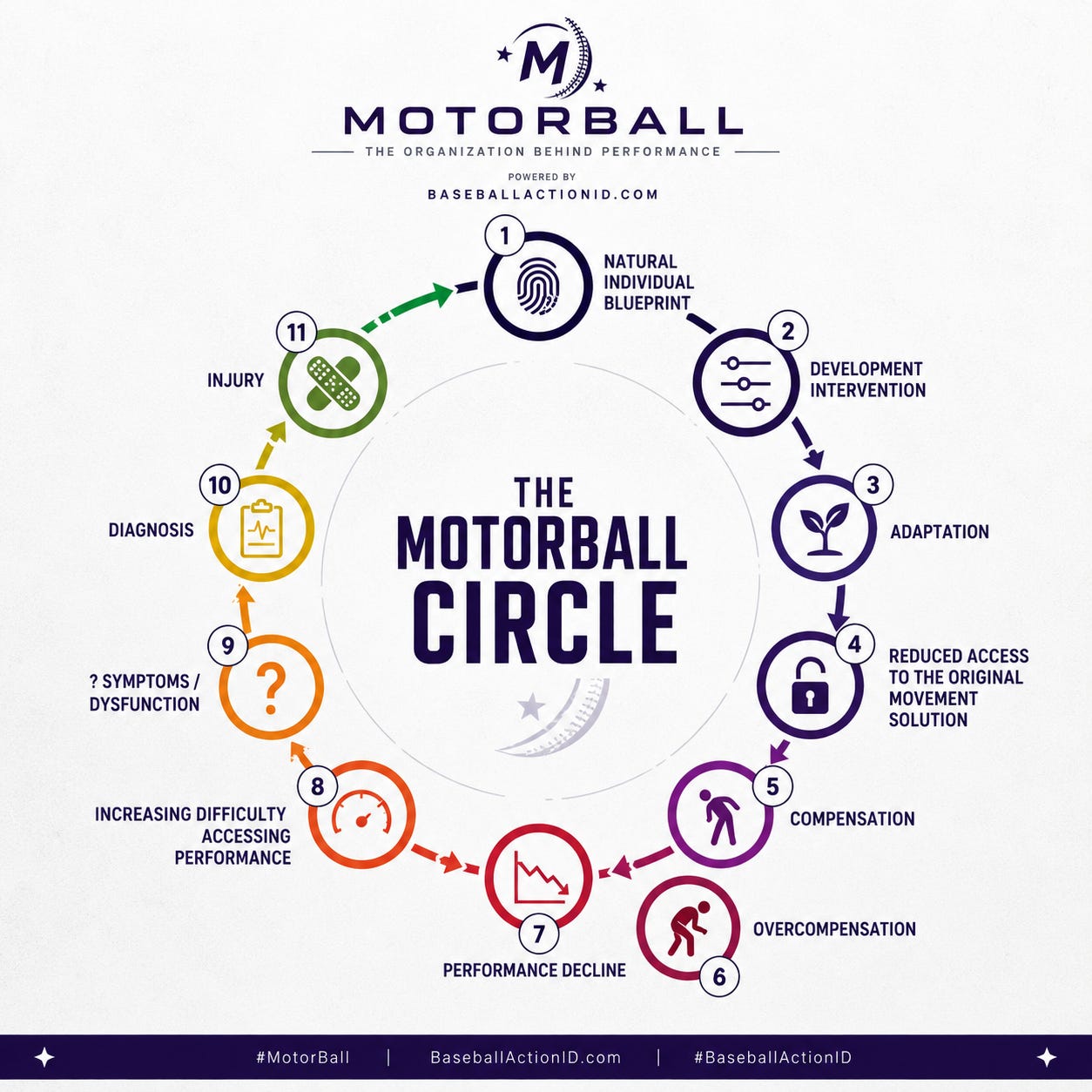
The question mark matters.
Because we don’t have an injury to explain.
We have an athlete whose performance and access to previous performance have changed.
And that brings us back to this week’s question.
If performance starts changing, what does the organization do?
Does it ask:
“What should we try?”
Or does it first ask:
“What has changed in this athlete — and do we understand why?”
PLAYER DEVELOPMENT SHOULD NOT BE A GUESSING GAME
There will always be uncertainty.
There will always be failed interventions.
There will always be decisions that don’t work.
That’s baseball.
But the goal of elite player development should not be to eliminate uncertainty.
It should be to reduce unnecessary uncertainty by understanding the individual better.
That’s a very different philosophy.
Because the objective isn’t simply:
Find something that works.
It is:
Understand the athlete well enough to know why something is likely to work for him.
That is a much higher standard.
SO, IS IT WORTH A SHOT?
Maybe.
But I think elite player development deserves a better question.
Not:
“Could this work?”
But:
“Why do we believe this is right for this athlete?”
Not:
“Did it work before?”
But:
“Why did it work before — and is that reason still present today?”
And certainly not:
“How do we reset the mechanics?”
But:
“Do we understand the human being producing the mechanics?”
Because when the athlete represents years of organizational investment and enormous asset value, the cost of getting the development question wrong isn’t just financial.
It can cost performance.
It can cost development time.
It can cost availability.
And potentially, it can cost the athlete access to the movement solution that made him successful in the first place.
So perhaps we should be more careful with four seemingly harmless words:
“It’s worth a shot.”
Because at the highest level of professional baseball, I think we should demand something better.
Is that player development — or is that organizational gambling?
Maybe the real competitive advantage isn’t finding more interventions.
Maybe it’s knowing your athlete well enough to know which interventions are worth trying.
That is where MotorBall starts asking a different question.