
COMMAND STARTS BEFORE THE TARGET
Why the Baseball Industry May Be Looking for Pitching Command in the Wrong Place
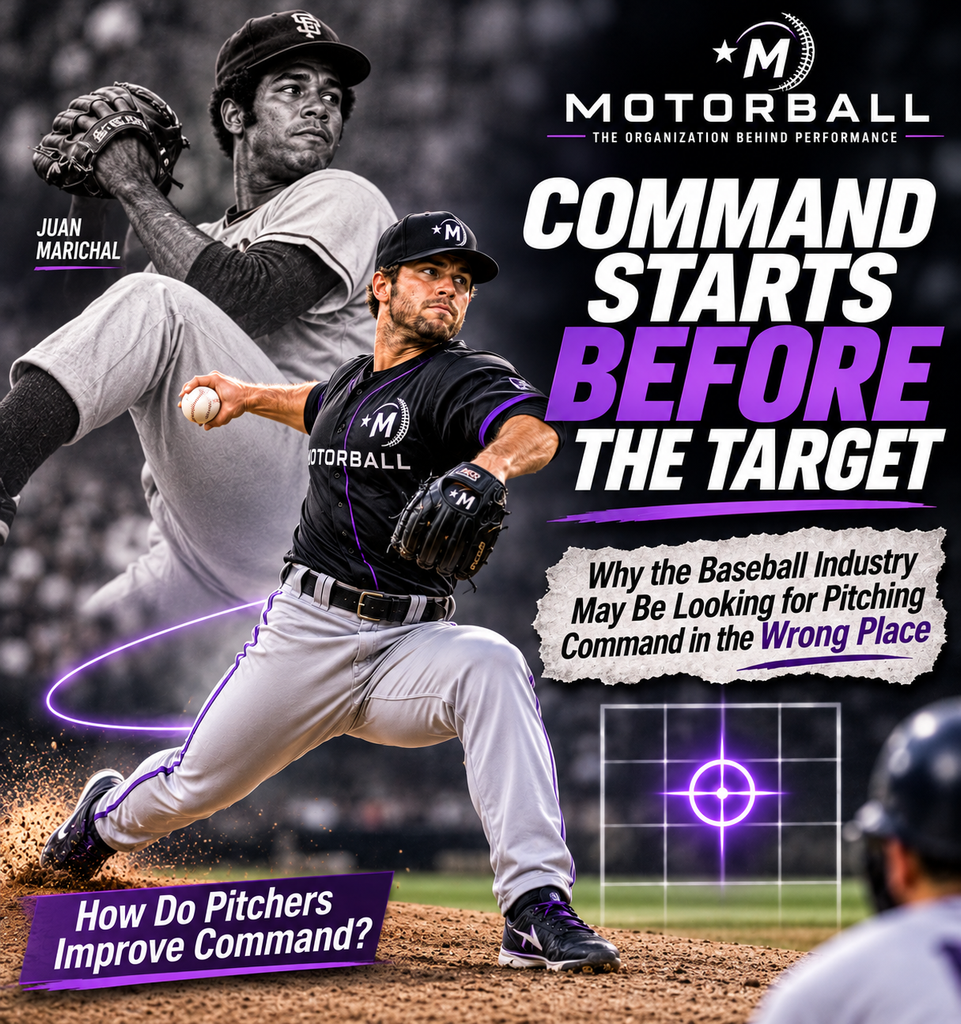
How Do Pitchers Improve Command?
It’s a question that regularly appears across baseball social media, coaching discussions, and player development conversations.
And the answers are often familiar:
Repeat the delivery.
Establish a consistent release point.
Improve focus.
Throw more bullpens.
Use smaller targets.
Build confidence.
There is nothing inherently wrong with these concepts. They can all have a place in pitcher development.
But there is a more fundamental question that deserves considerably more attention:
How can the baseball industry expect a pitcher to consistently command the baseball when the starting point of his movement is already outside his Natural Movement Blueprint?
That question changes the conversation.
Because before discussing how a pitcher can improve the outcome, shouldn’t the industry first understand the individual who is expected to produce it?
The contradiction nobody seems to question
Across professional baseball, individuality is constantly emphasized.
Every pitcher is different. Every delivery is unique. Player development should be individualized.
These statements are widely accepted.
But look at what happens when the industry evaluates how a pitcher moves.
The same mechanical reference points, preferred positions, movement expectations, and ideas about what an effective delivery should look like continue to influence how pitchers are assessed.
And there is the contradiction.
Individuality is acknowledged in conversation, but the underlying approach often remains remarkably standardized.
The industry says every pitcher is unique, yet frequently evaluates those pitchers against a common picture of how a delivery is supposed to look.
How can both positions be true?
If individual differences matter, they cannot suddenly become irrelevant when the conversation turns to movement organization and command.
A pitcher is not a standardized mechanical model with a different name, velocity reading, and uniform number.
He is an individual.
And that individuality has to mean something when evaluating how he organizes and executes movement.
Juan Marichal: An Individual, Not a Mechanical Exception
Juan Marichal had one of the most recognizable and unconventional pitching motions in baseball history. His distinctive delivery, including his exceptionally high leg kick, looked nothing like a conventional pitching template.
Yet Marichal was an outstanding control pitcher who l finished his career with just 1.82 walks per nine innings. He led the National League four times in fewest walks per nine innings.
Why should the appearance of a delivery be treated as a reliable indication of a pitcher’s ability to command the baseball?
An unconventional delivery does not automatically mean poor control. And a delivery that appears closer to a conventional mechanical reference does not automatically guarantee better control.
The point is not that one delivery is better than the other.
The point is that the individual cannot be understood simply by looking at how closely his delivery resembles a preferred mechanical model.
The movement has to be understood in relation to the person producing it.
And this is where Marichal becomes particularly interesting through the MotorBall lens.
Juan Marichal was not a biomechanical rebel. He was an outstanding example of what happens when a pitcher’s natural movement organization is allowed to lead rather than being judged against conventional mechanical expectations.
Through the MotorBall framework, Marichal represents the expression of an R-profile: his natural vertical organization, shoulder-driven acceleration, and superior rhythmic dissociation were integral to how he organized and executed his pitching action.
These characteristics were not deviations that needed to be corrected.
They were part of his individual movement blueprint.
Marichal did not need to conform to a universal mechanical template to demonstrate exceptional control.
His example reinforces a fundamental question:
Are pitchers being evaluated according to how well they organize movement for their own individual blueprint, or according to how closely they resemble an expected mechanical model?
The automatic mechanical explanation
Consider what frequently happens when a pitcher starts struggling with command.
How quickly does the conversation turn to familiar explanations?
“There’s a mechanical issue.”
“He’s out of sync.”
“He needs a mechanical reset.”
“Let’s get him back into the lab.”
“We need to clean up his delivery.”
Perhaps those observations are sometimes correct.
But why do they so often become the starting point rather than the beginning of a deeper investigation?
When someone says a pitcher is “out of sync,” what exactly is being used as the reference?
When someone says he needs a mechanical reset, what determines the movement organization he should be reset toward?
And when a pitcher is sent back to the lab, is the evaluation identifying how that individual naturally organizes movement, or primarily comparing his delivery against established mechanical expectations?
These are not minor distinctions.
You cannot meaningfully define what being out of sync means for an individual without first understanding what being in sync looks like for that individual.
Otherwise, the industry risks interpreting individual movement differences as mechanical problems simply because they do not fit an expected picture.
A mechanical observation is not automatically an explanation of the underlying cause.
And a recommendation to repeat, adjust, or reset a movement pattern does not answer the more fundamental question:
Does that movement pattern actually fit the individual?
The starting point matters
Imagine asking a naturally left-handed person to write with their right hand.
Then imagine evaluating the quality of their handwriting, adjusting their grip, changing the angle of the pen, giving them smaller targets, and demanding more repetitions.
The person might improve at performing the task under those conditions.
But an important question remains:
Why was the task organized around an assumption that did not fit the individual in the first place?
This is a deliberately exaggerated analogy, not a literal comparison with pitching. Pitching is considerably more complex.
But it exposes a principle that deserves attention in player development: improving the execution of a task and understanding whether the starting point fits the individual are not necessarily the same thing.
Now bring that question back to the mound.
Two pitchers can be given the same target, the same instruction, and the same command-development exercise.
Yet their natural movement organization may be fundamentally different.
Why should the industry automatically assume that the same mechanical reference points provide an equally appropriate starting point for both?
And if a pitcher’s movement organization does not align with his Natural Movement Blueprint, why would simply demanding more consistency, more repetitions, or a more repeatable delivery necessarily address the underlying issue?
The industry may be trying to improve the execution without first understanding the organization behind it.
Command cannot be separated from the individual producing it
Command is often discussed as though it were primarily a matter of controlling the baseball: directing it to a location, repeating a release point, and reproducing a desired result.
But the baseball does not move itself.
Every pitch is the result of an individual organizing and coordinating movement to execute an intended action.
That process begins before the ball leaves the hand. It begins before the release point. And it begins before the delivery becomes visible as a sequence of positions that can be measured and evaluated.
Within the MotorBall framework, this is where the Natural Movement Blueprint and Motor Signature become relevant.
They provide a different lens through which to understand how an individual naturally organizes movement.
The question is not simply whether a pitcher can reach a particular position or reproduce a particular movement pattern.
The question is whether the way he is organizing his body supports the action he is being asked to perform.
That distinction matters.
A visually similar delivery does not automatically mean two pitchers are organizing movement in the same way.
And a delivery that looks different from a conventional reference model is not automatically a delivery that needs to be judged against that model.
The individual has to be understood before the movement can be meaningfully interpreted.
This is not an argument against biomechanics, technology, or performance measurement. Those tools can provide valuable information about what happens during a pitch.
But measuring the outcome, describing visible movement, and understanding the individual organization behind that movement are different levels of information.
One does not automatically explain the other.
Before the next command drill
The baseball industry invests enormous resources in measuring pitch characteristics, analyzing delivery mechanics, evaluating performance, and developing command.
Yet one fundamental question deserves to be asked much earlier in that process:
Does the pitcher’s current movement organization support the way he is being asked to execute the pitch?
Not according to a generic model.
Not according to what another pitcher does.
Not simply because a particular position or movement pattern is considered desirable.
But in relation to the individual pitcher himself.
If that starting point has not been understood, the industry may be trying to improve command without fully understanding the person responsible for producing it.
That does not mean every command problem originates in a mismatch with a Natural Movement Blueprint. Command is multifactorial, and no single framework should claim to explain every pitching outcome.
But it does mean that individual movement organization should not be overlooked when evaluating and developing a pitcher’s ability to execute consistently.
The industry has spent years discussing individualization.
Perhaps it is time to take that principle seriously at a much deeper level.
Because individualization cannot stop at assigning a personalized development plan or adjusting a few visible mechanical details.
It has to begin with understanding the individual.
And that brings the conversation back to the question that started this article:
HOW CAN THE BASEBALL INDUSTRY EXPECT COMMAND FROM A PITCHER WITHOUT FIRST UNDERSTANDING HOW THAT INDIVIDUAL IS NATURALLY ORGANIZED TO MOVE?
Command starts before the ball leaves the hand.
And perhaps the most important conversation about command needs to start before the industry decides what the pitcher’s movement is supposed to look like.

